REVIEW · BERLIN
Berlin sightseeing boat tour on the Spree
Book on Viator →Operated by Reederei BWSG · Bookable on Viator
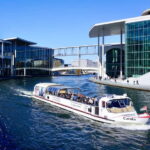
A boat makes Berlin feel easier—especially on day one. You’ll glide past the big riverside hits with German and English GPS audio, plus seated comfort instead of constant walking.
What I like most is the value—about $26 for a full city-sight overview—and the way the Spree turns famous landmarks into photo angles you can’t get from sidewalks. One drawback to plan for: the audio timing and English pacing can slip a bit, so you may want to watch the buildings as you go.
In This Review
- Key highlights before you board
- The Spree is a smart way to see Berlin in one hour
- Price and what you really get for the money
- Where the tour starts: Alte Börse (BWSG) and what to expect onboard
- How the GPS audio works (and how to avoid missing the best moments)
- The one-hour route: Museum Island, then toward Reichstag and the river government stretch
- Lustgarten and the Berlin Cathedral: a big landmark right by the museum core
- The Humboldt Forum by the Berlin Palace: culture with a modern museum footprint
- Mühlendammschleuse and Nikolaiviertel: Berlin’s older layers meet the river’s mechanics
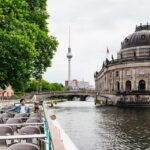
- Berlin Television Tower: the skyline marker you’ll recognize instantly
- Museum Island: UNESCO-level museum architecture, seen as one continuous river view
- Reichstag and the glass dome view: power, rebuilt, and rebuilt again
- Berlin Hauptbahnhof: the modern train-station giant in the middle of sightseeing
- Federal Chancellery and the Spreebogen area: the political Berlin you can spot from far away
- House of World Cultures (HKW): contemporary art in the old congress-hall shape
- The best way to use this tour (so you actually learn something)
- Who should book this Spree boat tour?
- Should you book it? My call
- FAQ
- How long is the Berlin Spree sightseeing boat trip?
- How much does the tour cost?
- Where does the tour meet and start?
- Is the tour offered in English?
- Is there an onboard toilet?
- Are snacks included in the price?
- Can I buy drinks onboard?
- Is this a private tour?
- Are service animals allowed?
- What’s the best way to handle ticket collection at the start?
- Do I need to cancel far in advance to get a full refund?
Key highlights before you board
- Comfort-first sightseeing: seated, calm pacing that’s easier than a walking route.
- German and English audio via GPS: the ship triggers descriptions as you pass sights.
- Museum Island from the water: Cathedral and the UNESCO museum cluster show up as a single dramatic stretch.
- Government-district views: Reichstag, Federal Chancellery, and the cultural riverfront all read differently from the Spree.
- Photo timing matters: pick the sides with good light if you want sharper skyline shots.
- Drinks onboard (snacks not included): bar service is available, and you can plan your hour around it.
The Spree is a smart way to see Berlin in one hour
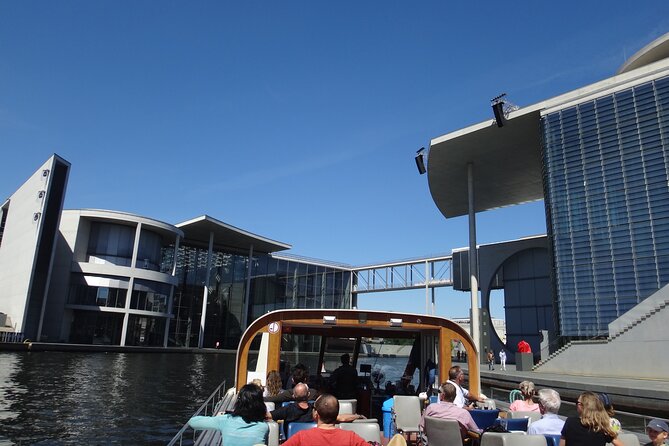
Berlin can be a lot in the best way—history, layers, and architecture everywhere. This boat tour is built for the opposite problem: when your feet need a break but your eyes still want the highlights. For $26.36 and roughly one hour, you get a concentrated pass along central Berlin’s riverfront, with famous places spread out like a living photo album.
I especially like that you’re not stuck in one neighborhood. The Spree pulls you through the city’s core: grand museum buildings, the government district, and the skyline landmarks that anchor Berlin in photos. And because the format is seated, you can actually stay present. No sprinting between monuments. No guessing where the next stop is.
One heads-up: this tour uses pre-recorded audio (German first, then English) delivered by onboard speakers as you pass landmarks. That’s usually fine, but a few reviews note the English narration can arrive after you’ve already passed a sight, or the volume can be hard to hear when the boat gets noisy.
You can also read our reviews of more boat tours in Berlin

Price and what you really get for the money
At $26.36 per person for about 1 hour, this isn’t a “do everything” Berlin plan. It’s a strong orientation tool. Think of it like this: you’re paying for time-saved sightseeing—reduced walking, continuous views, and a simple overview of where key sites sit along the Spree.
To judge value, I look at three things:
- Duration: 60 minutes is long enough to feel like you saw real Berlin, but short enough not to drag.
- Comfort vs. walking: the seated format can be worth it even if you later come back on foot.
- Information support: GPS-based audio helps you place what you’re seeing without needing to stop and read every sign.
What’s not included is snacks. The boat does offer drinks for purchase (including bar service in the onboard setup), so you can still make the hour feel like a relaxed outing rather than a hurried transit.
Where the tour starts: Alte Börse (BWSG) and what to expect onboard
You’ll meet at Anlegestelle Alte Börse / BWSG Berliner Wassersport und Service GmbH, Burgstraße 27, 10178 Berlin. This is the kind of meeting spot that keeps things straightforward: you show up, you board, and you spend your time on the water.
The boat setup is designed for comfort. There’s toilet access onboard, and there’s covered seating under deck, which helps on breezy or changeable days. Some boats also have a visual component (TV screens showing route and surroundings), which can be handy when the audio is hard to line up perfectly with the view.
A practical note from real-world experience: boarding sometimes involves collecting or dealing with a ticket print-out at/near the entrance kiosk. I’d plan a little extra buffer for that moment, especially if you’re traveling on a tight schedule.
How the GPS audio works (and how to avoid missing the best moments)
This is an audio-led tour. The narration is delivered through onboard speakers in both German and English, with GPS controlling when the descriptions play. That’s a smart idea in theory: the audio tries to match the exact building you’re passing.
In practice, you can reduce frustration with two simple tactics:
- Look first, listen second. If English comes a touch late, you’ll still understand the building because you’ll have already seen it.
- Choose your seat with hearing in mind. If you’re seated farther from speakers, volume issues can feel worse when other passengers get loud.
There’s also a “fix it if needed” option: the company response indicates you can get a free audio guide so you can listen in the language you want at your own volume. That won’t fix the view, but it can save the tour for people who really care about accurate timing.
The one-hour route: Museum Island, then toward Reichstag and the river government stretch
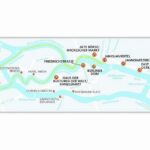
The route is a tour of Berlin’s central spine. You start in the Mitte area and travel along the Spree, where major sights cluster around the waterline. The stop list covers everything you’d expect for a “greatest hits” cruise—just in a tighter, easier format.
Here’s the logic of the ride: Berlin’s landmarks aren’t just scattered. They line up in a way that makes the river feel like a timeline. You’ll see places tied to Prussian-era culture and museum power, then swing toward East/West-era political symbolism, and finally end in the modern cultural layer of the Spreefront.


Lustgarten and the Berlin Cathedral: a big landmark right by the museum core
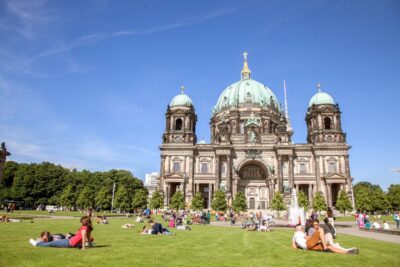
One of the first major anchors you pass is Oberpfarr- und Domkirche zu Berlin at the Lustgarten on Museum Island. This Protestant church was built 1894–1905 in Neo-Renaissance and Neo-Baroque styles, designed by Julius Raschdorff. It’s also described as the largest Protestant church in Germany by area and one of Europe’s key dynastic burial sites.
From the water, this matters because the Cathedral becomes more than a stop. It turns into a skyline feature that you can frame with the river and the museum buildings behind it. If you like photos, treat this part of the ride like your warm-up shot series: you’ll likely get the clearest “Berlin instantly recognizable” compositions here.
The Humboldt Forum by the Berlin Palace: culture with a modern museum footprint
Next up is the Humboldt Forum in the Berlin Palace complex. It’s positioned as a universal museum and includes parts of the Berlin State Museums: the Ethnological Museum and the Museum of Asian Art, plus it houses the Berlin City Museum and the Humboldt Laboratory of Humboldt University of Berlin. The building also hosts events, exhibitions, and guided tours under support from the Humboldt Forum Foundation.
Why it works on a boat: this is the kind of building that’s easy to see but harder to fully understand from a sidewalk without context. On the cruise, you get a fast relationship between the architecture and the riverfront space—how it sits in the Mitte cityscape.
Also, because it’s tied to Museum Island’s wider complex, this stop helps you mentally map the “museum cluster” zone. Even if you don’t go inside today, you’ll know where to aim your next visit.
Mühlendammschleuse and Nikolaiviertel: Berlin’s older layers meet the river’s mechanics
As the tour moves along the Spree, you pass Mühlendammschleuse, a lock in Mitte, east of Mühlendamm on the Fischerinsel. The lock sits in the Spree-Oder waterway here and is tied to an older town connection between Berlin and Cölln—material that connects to how Berlin grew.
The lock itself has a clear engineering fact: it was put into operation in 1942 and it overcomes a drop of 1.51 meters. This is a great reminder that Berlin isn’t only monuments and museums. The city runs on infrastructure too—and the river is one of its main systems.
Then you reach Nikolaiviertel, described as Berlin’s oldest settlement area in the capital. Much of it was destroyed in World War II and rebuilt in 1980–1987 by architect Günter Stahn for the city’s 750th anniversary, around the reconstructed Nikolaikirche. The area combines a near-medieval floor plan with an ensemble of historic town houses and adapted prefabricated buildings, making it a recognizable “old Berlin” pocket.
From the boat, this stop tends to feel special because Nikolaiviertel is compact. You can often take in the riverfront edge quickly, then imagine the streets above it—exactly what you want from a short tour.
Berlin Television Tower: the skyline marker you’ll recognize instantly
At 368 meters, the Berlin television tower is the tallest building in Germany and a major skyline landmark. It was completed in 1969 and was the second highest television tower in the world at the time. The tower reportedly draws over a million visitors a year, which makes it a practical reference point for where you are in the city.
On the Spree, this tower functions like an orientation beacon. It’s the kind of sight you can use to check your mental map: you’ll realize you’re not just passing buildings—you’re moving through the city’s core geometry.
If you’re photo-minded, this is where the advice about timing really matters. Choose the side that gives you the best background light. Even a small shift in angle can change a skyline photo from “tower shot” to “tower in context.”
Museum Island: UNESCO-level museum architecture, seen as one continuous river view
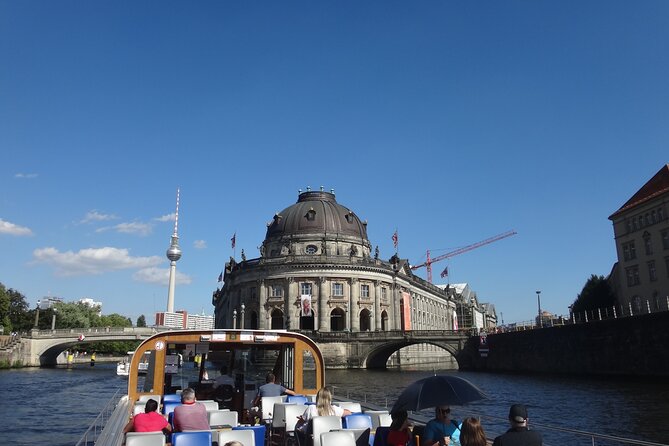
Museum Island is the big cultural showpiece you’ll likely remember from this cruise. It’s the ensemble of five museums on the northern part of the Spreeinsel: Old Museum, New Museum, Old National Gallery, Bode Museum, and Pergamon Museum. Built between 1830 and 1930, it was created on behalf of the Prussian kings according to plans by five architects, and the whole island was listed as UNESCO World Heritage in 1999.
The area has continued to evolve too. After reunification, it was renovated and expanded as part of a master plan, and the James Simon Gallery opened as a new visitor center in July 2019.
Here’s the key value of seeing Museum Island from the water: you understand scale. From the ground, you might feel like each museum is separate. From the river, you get the island as a single cultural corridor—buildings stacked as a coordinated statement.
Even if the audio is slightly off in timing, you’ll still catch the bigger story: this stretch is Berlin’s long-form museum ambition, lined up along the water.
Reichstag and the glass dome view: power, rebuilt, and rebuilt again
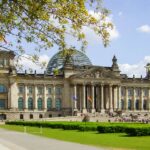
No Berlin “highlights” list is complete without the Reichstag. The building has been the seat of the German Bundestag since 1999. It was built 1884–1894 in Neo-Renaissance style, designed by Paul Wallot. It later housed both the Reichstag of the German Empire and the Weimar Republic.
The Reichstag suffered severe damage from the Reichstag fire of 1933 and World War II, then was restored in a modernized form in the 1960s. From 1995 to 1999, it underwent a major redesign by Norman Foster for permanent parliamentary use, with the glass dome above the plenary hall based on an idea by Gottfried Böhm.
From the Spree, the dome and façade can feel more dramatic because you’re viewing them across open river space. It’s one of the better “monument + modern function” reads you can get in an hour.
Practical photo tip: the dome shot often benefits from standing still at the rail (if you’re allowed and it’s safe) and using the river reflections for depth.
Berlin Hauptbahnhof: the modern train-station giant in the middle of sightseeing
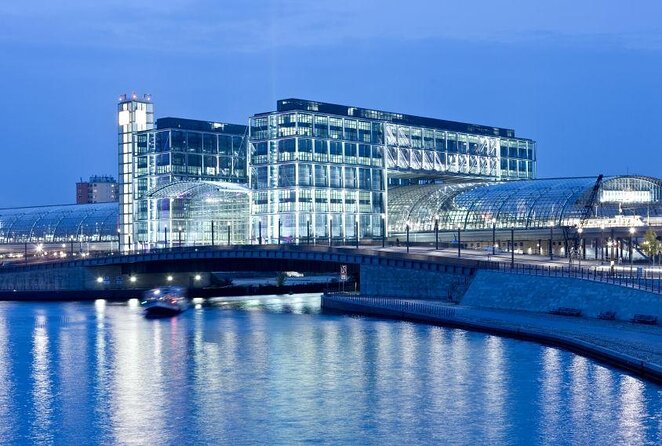
One surprise on this cruise is how often the modern city intrudes—in a good way. Berlin Hauptbahnhof is the most important passenger station in Berlin and is described as the largest tower station in Europe. Roughly 330,000 travelers and visitors use it daily, and around 1,300 trains stop there each day.
It’s also a major transfer hub with 14 platform tracks and multiple connections via trams and subway nearby (the station has a U-Bahn stop named the same). The striking design is credited to Meinhard von Gerkan.
Why include a train station in a sightseeing cruise? Because Berlin is not frozen in postcard history. Seeing Hauptbahnhof from the water reinforces the idea that this city is a working hub. It also gives you a practical “where is everything” reference point if you’re planning day-to-day travel.
Federal Chancellery and the Spreebogen area: the political Berlin you can spot from far away
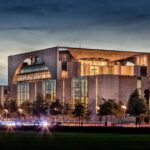
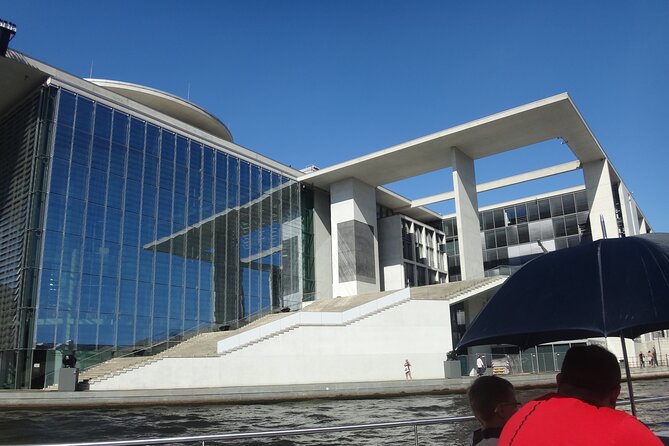
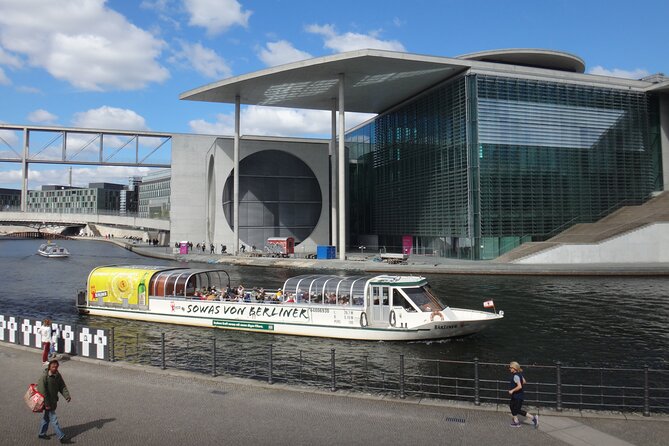
The Federal Chancellery building is the HQ that supports the German Federal Chancellor. Since 2001, its new building has served as the seat of the authorities in Berlin’s Spreebogen, designed by Axel Schultes, and it’s separated from the Reichstag by Platz der Republik.
The building opens onto a central square opposite the Paul-Löbe-Haus, intended as a citizens’ forum. It’s part of a building group at Spreebogenpark called Bund des Bunds.
From a boat, political buildings can feel oddly human—not because they change, but because you get distance and context. You see the spacing between institutions, which helps the government district feel less like a confusing blur and more like an intentional zone.
House of World Cultures (HKW): contemporary art in the old congress-hall shape
The final cultural note on the route is House of World Cultures (HKW). It’s an exhibition space for international contemporary art and a forum for current developments and discourses, with special attention to non-European cultures and societies.
The HKW has been based since March 1989 in the former congress hall on the Spree’s banks in the Tiergarten and government district. That building is described as an icon of modernism and a symbol of the German-American alliance. In Berlin slang, it’s nicknamed the Pregnant Oyster because of its shape.
From the water, this is the kind of architecture you can spot even when you don’t know the official name. It gives the cruise a “modern Berlin continues after the big monuments” message—useful if your itinerary still needs places to rest your eyes after all the stone grandeur.
The best way to use this tour (so you actually learn something)
This tour works best when you treat it as a tool, not an endpoint. I’d use it like this:
- Book it early in your visit to get your bearing fast along the Spree.
- Come back later on foot to the spots that grab you most—Museum Island and the Reichstag area are obvious candidates.
- Bring patience for the audio: watch the buildings, not just the speaker timing.
If you’re sensitive to sound quality, sit where you feel you can hear the narration clearly. And if you’re an English-only listener, it’s smart to remember that English descriptions may lag behind what you pass.
Who should book this Spree boat tour?
This is a great fit if you want:
- A low-effort introduction to central Berlin
- Waterfront views that you can’t easily replicate from street level
- Seated sightseeing during a packed schedule
It may not be the best fit if:
- You strongly depend on the English audio lining up perfectly to each building
- You dislike mixed-language timing (German plays first)
- You need very quiet conditions to focus
A related practical point: at peak times, boats can feel full. When seating is tight, it’s harder to hear and harder to find your ideal angle.
Should you book it? My call
If your goal is a simple, seated, one-hour overview of Berlin’s main sights along the Spree, I’d book this. The price-to-time ratio is hard to beat, and the route covers the kind of landmarks you’ll build the rest of your trip around—Museum Island, Reichstag, the government stretch, and the TV Tower skyline marker.
If you’re taking the cruise mainly for perfect, perfectly timed English narration, I’d go in with a plan: watch the sights as you pass and be ready to use the audio-guide option if offered to you. For a relaxed hour that helps you map the city, this cruise is a solid yes.
FAQ
How long is the Berlin Spree sightseeing boat trip?
It runs for about 1 hour.
How much does the tour cost?
The price is $26.36 per person.
Where does the tour meet and start?
The meeting point is Anlegestelle Alte Börse / BWSG Berliner Wassersport und Service GmbH, Burgstraße 27, 10178 Berlin.
Is the tour offered in English?
Yes. English is available.
Is there an onboard toilet?
Yes, there is a toilet on board.
Are snacks included in the price?
No. Snacks are not included.
Can I buy drinks onboard?
Yes. There is bar service / drinks for purchase onboard.
Is this a private tour?
It’s listed as a private tour/activity, meaning only your group participates.
Are service animals allowed?
Yes, service animals are allowed.
What’s the best way to handle ticket collection at the start?
Confirmation is received at booking, but you may still need to collect or exchange for a physical boarding pass at the nearby point of entry. I suggest arriving with enough buffer time to handle that step.
Do I need to cancel far in advance to get a full refund?
Yes. You can cancel up to 24 hours in advance for a full refund, based on local time.