REVIEW · BERLIN
Berlin East Side Tour 2.5 hour cruise with commentary
Book on Viator →Operated by Reederei BWSG · Bookable on Viator
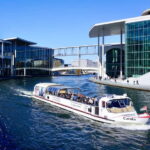
A Spree cruise turns Berlin into a moving timeline. This 2.5-hour boat ride threads together major sights from the Museum Island area to the East Side Gallery, and it does it with real storytelling as you pass bridges, locks, and Cold War landmarks.
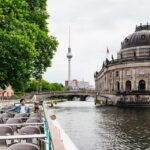
I particularly like two things: the top-deck views (it’s the best way to see the skyline and riverfront) and the live commentary that makes stops feel connected instead of like a pile of photos.
One drawback: the experience can feel tight and warm on board, and sound can be a bit harder up top, so plan your seat choice if you want clear English the whole way.
In This Review
- Quick hits
- Two and a half hours on the Spree: what the timing buys you
- Where you board at Alte Börse and how to get a comfortable spot
- Live English and German commentary: how to make it work for you
- Lustgarten to Humboldt Forum: Museum Island from the water
- Mühlendammschleuse and Berlin’s founding lock story
- The East Side Gallery: the Wall’s outdoor art and its complicated survival
- Bridges, the old shipping system, and the Molecule Man
- Nikolaiviertel and the Berlin TV Tower: old Berlin made visible
- Schiffbauerdamm and the stretch that explains Berlin’s riverfront economy
- Reichstag, Kronprinzenbrücke, and Humboldthafen: government power in plain view
- Federal Chancellery and House of World Cultures: modern Berlin’s different voices
- Palace of Tears and Weidendammer Bridge: Cold War edges you can feel
- Wrapping up near Bode Museum: ending on UNESCO-level art ambition
- Price and value: when 36.04 makes sense
- Should you book this Berlin East Side cruise?
- FAQ
- How long is the cruise?
- What language is the commentary?
- Where do I meet the tour?
- What time does the tour start?
- Is there anything to buy onboard?
- Can I cancel for a refund?
Quick hits
- Top deck is where the city looks right for photos and skyline views
- Mühlendammschleuse lock moment: you slow down where Berlin’s water story began
- East Side Gallery section of the Wall: art, politics, and replicas with meaning
- Way more than the 1-hour cruises: you reach farther downriver and back
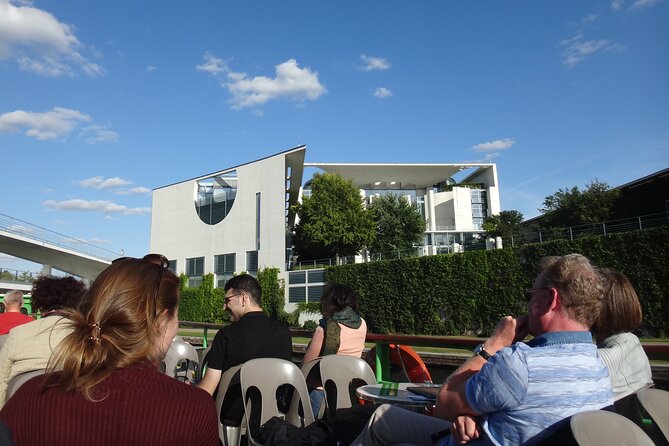
- Government district from the water: Reichstag, Chancellery, and the Spreebogen riverfront
- Live commentary in English and German with occasional hearing challenges depending on where you sit
Two and a half hours on the Spree: what the timing buys you
This isn’t a “one landmark, one angle” kind of cruise. The schedule is long enough to reach farther along the Spree, so you get a mix of Berlin styles: imperial-era architecture, Cold War scars, and the post-reunification government district. In plain terms, you cover more ground without feeling like you’re stuck on the boat for ages.
You’ll start mid-afternoon at 2:45 pm and you’re back at the same pier afterward. That works nicely as a day-2 starter, or as a calmer alternative to a full walking block. It’s also a good choice if you want a lot of orientation fast: Berlin can be confusing on foot until you see how the river knits the neighborhoods together.
You can also read our reviews of more boat tours in Berlin
Where you board at Alte Börse and how to get a comfortable spot
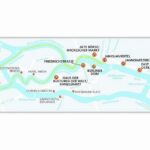
Boarding happens at Anlegestelle Alte Börse, Burgstraße 27, 10178 Berlin, which is in central Mitte. The big practical win here is convenience: you’re near public transportation, and it’s easy to pair the cruise with Museum Island or the government area you might already be planning to visit.
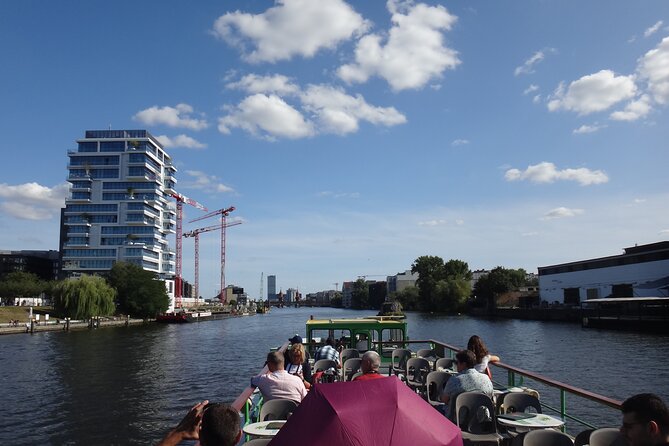
One caution from the vibe on the boat: seating can feel tight, especially if you end up with connected rows. If you’re sensitive to that, arrive early enough to choose a spot instead of grabbing whatever’s left. If you’re also sensitive to heat or air quality, you’ll likely prefer the outside deck when weather allows, and the lower salon only when you’re sure it’s not getting stuffy.
Also, there’s a toilet onboard and an onboard bar, so you can plan around that without turning the whole trip into a bathroom-and-snack logistics exercise.
Live English and German commentary: how to make it work for you
The cruise runs with live commentary in English and German. When it’s going well, it’s one of the best ways to learn Berlin because the narration keeps tying the riverfront buildings to the city’s shifts in power, borders, and identity.
Sound can be the weak point. Some people find it harder to hear up on the top deck, while others are happy as long as they’re sitting in the right place. My practical tip: if English is your main language, choose seats so you’re close enough to the speakers and not blocked by bodies, railings, or the angle of the boat. On breezy days you might get more comfort outside, but the tradeoff can be audio clarity—so adjust seat location accordingly.
Lustgarten to Humboldt Forum: Museum Island from the water
One of the smartest parts of this cruise is that it threads right by the Museum Island zone, where Berlin’s “this is what rulers cared about” energy is obvious.
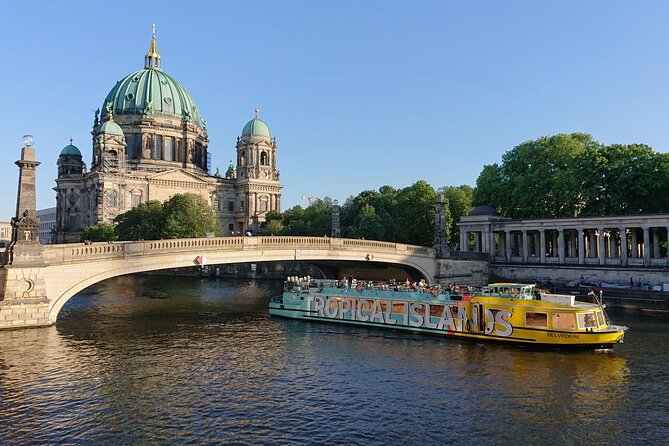
You pass the Berlin Cathedral at the Lustgarten. It’s the big Protestant church built in the period 1894–1905, in Neo-Renaissance and Neo-Baroque style. Even if you’re not planning to step inside during this trip, seeing it from water level helps you understand the scale—and why it matters as one of Europe’s notable dynastic burial sites.
Close by is the Humboldt Forum in the Berlin Palace. It’s a “universal museum” type of place with the Ethnological Museum and Museum of Asian Art as part of Berlin State Museums, plus other programming under the Humboldt Forum umbrella. From the boat, it’s a good moment to connect the history of a place with what it’s used for now. Berlin loves that contrast: old power turned into public culture.
As you continue along, you’ll also glide past the broader Museum Island complex and the collection-heavy vibe of the area: the Old Museum, New Museum, Old National Gallery, Bode Museum, and Pergamon Museum. You won’t do museum homework on a 2.5-hour cruise, but you’ll get a clear sense of where the clusters are and how the island sits in the river.
Mühlendammschleuse and Berlin’s founding lock story
This is the cruise moment that gives you something more unusual than “just sightseeing.” You slow down at the Mühlendammschleuse lock in Mitte, east of Mühlendamm near Fischerinsel. It lies on the Spree-Oder waterway route, and it’s tied to the early connection between Berlin and Cölln, the origins of Berlin as a city.
Here are the details that make the stop feel real, not generic:
- The lock has been operating since 1942
- It overcomes a drop of 1.51 meters
- There’s a roughly 20-minute stop connected to lock time, which also becomes a natural break in the flow of the narrative
On board, this part helps you understand the Spree not just as a view corridor but as infrastructure. Berlin’s history didn’t happen on dry streets only. Water routes shaped trade, control, and movement.

The East Side Gallery: the Wall’s outdoor art and its complicated survival
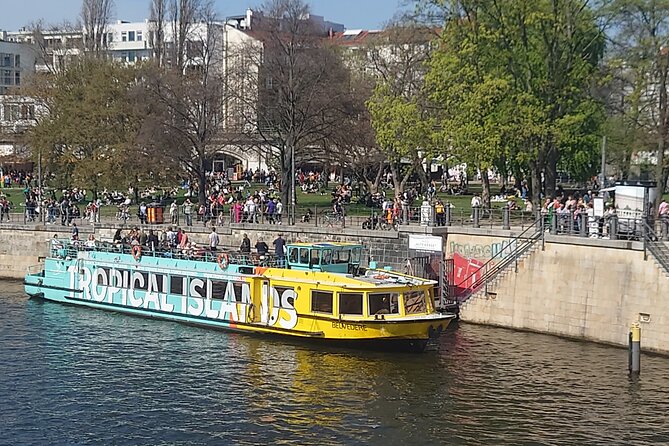
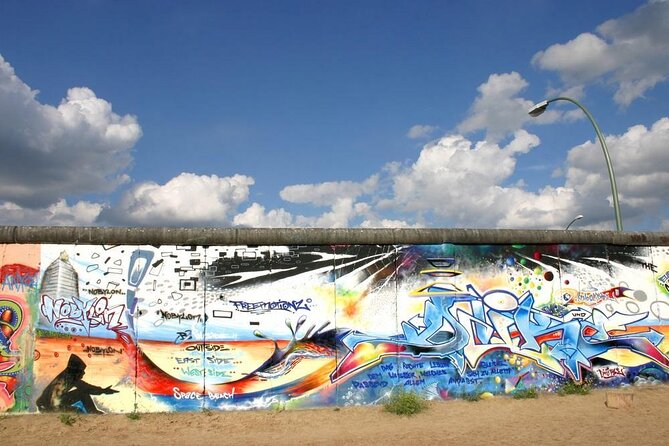
Then comes the big emotional stop: the East Side Gallery in Friedrichshain. This is an open-air memorial along the longest surviving section of the Berlin Wall on Mühlenstraße, stretching between Berlin Ostbahnhof and the Oberbaum Bridge area.
What you’ll see and what matters:
- After the Wall opened in spring 1990, 118 artists from 21 countries painted the section
- The art spans 1316 meters
- It was created on the side that used to face East Berlin, responding to the political changes of 1989/90
- Urban planning altered the original preservation, so what you see today includes replicas from 2009
A cruise is a funny way to experience wall art—because you’re moving and you’re not “in the crowd”—but that distance can be useful. It helps you see the Wall section as a long linear scar that the riverfront still anchors. If you’re the kind of person who wants meaning, this stop is one of the best reasons to choose the longer 2.5-hour version.
Bridges, the old shipping system, and the Molecule Man
Between Wall art and downtown monuments, the cruise keeps delivering visual anchors: bridges, sculptures, and river edges.
You’ll pass the story-heavy stretch near the Oberbaum Bridge area, where Berlin once used wooden bridges tied to customs collection. The cruise narration typically points out how the Spree was blocked on both sides except for a narrow pass with walkable wooden walkways, then secured at night with a reinforced trunk called a tree. That’s the kind of detail you’d miss on foot unless you already know where to look.
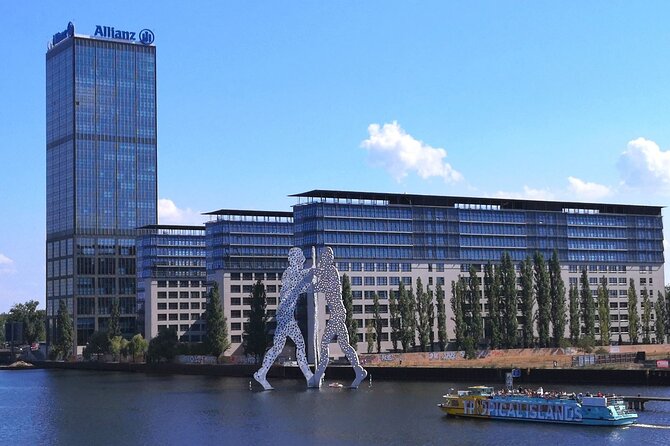
Another memorable landmark is Molecule Man, a monumental sculpture by Jonathan Borofsky. It’s a three-person work placed in the Spree between Elsenbrücke and Oberbaumbrücke near the border of Kreuzberg, Alt-Treptow, and Friedrichshain. From the boat, it reads differently than it does in street photos because you’re seeing its relationship to water height, bridge shadows, and river traffic.
This section is also where the cruise delivers the “wow, Berlin is not tidy” feeling. You get art, engineering, and raw history in the same frame.
Nikolaiviertel and the Berlin TV Tower: old Berlin made visible
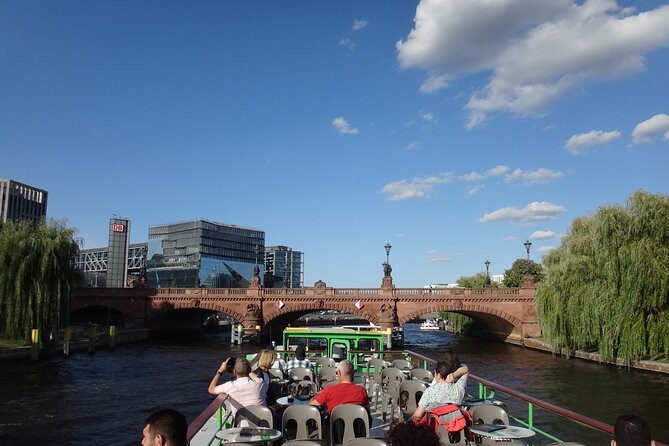
As the cruise continues through Mitte’s core, you’ll glide by Nikolaiviertel, Berlin’s oldest settlement area. It was heavily damaged in World War II, then rebuilt in 1980–1987 by architect Günter Stahn for Berlin’s 750th anniversary celebrations.
What’s interesting here is the reconstruction approach: it’s built around the Nikolaikirche, and it uses a medieval-style floor plan with an ensemble of historic town houses plus adapted prefab buildings. From the river, you’ll get a sense of how Berlin can feel “old” in a way that’s actually modern reconstruction. That’s not a criticism—it’s part of how the city chooses to remember.
You’ll also pass the Berlin TV Tower, at 368 meters, the tallest building in Germany. When it opened in 1969, it was the second highest TV tower in the world. It’s become one of Berlin’s most visited landmarks, and seeing it from the water gives you a different angle on why it’s such a hard-to-miss focal point.
Schiffbauerdamm and the stretch that explains Berlin’s riverfront economy
You’ll also pass Schiffbauerdamm, the street along the right bank of the Spree between Weidendammer Bridge and Reinhardtstraße. The name comes from the shipbuilding businesses that used to be there.
This is a small stop on the mental map, but it helps you read the riverfront. Instead of treating it like a scenic promenade, you start seeing it as a worked edge where industry, transport, and later government buildings all took turns.
If you like understanding why Berlin looks the way it does, these “in-between” slices are where the cruise earns its keep.
Reichstag, Kronprinzenbrücke, and Humboldthafen: government power in plain view
As you move toward the government core, the cruise gives you a clear water-level view of Germany’s political heart.
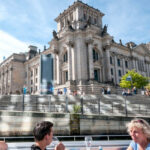
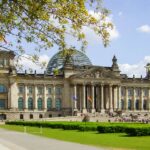
You pass the Reichstag on Republic Square, built 1884–1894 in Neo-Renaissance style. After damage and a long restoration period, it was redesigned 1995–1999 by Norman Foster for permanent parliamentary use. The accessible glass dome above the plenary hall is a defining feature of modern Berlin’s image of transparency.
Just adjacent you’ll pass the Kronprinzenbrücke, linking Mitte and Tiergarten and leading toward the Spreebogen park area and nearby civic buildings. Then there’s Humboldthafen, the dock basin named after Alexander von Humboldt, with a water surface of 33,500 m² and an average depth around 3.5 meters.
These pieces matter because they show a pattern: the Spree isn’t just a backdrop. It’s a staging area for how Germany projects itself—history and governance on the same river.
Federal Chancellery and House of World Cultures: modern Berlin’s different voices
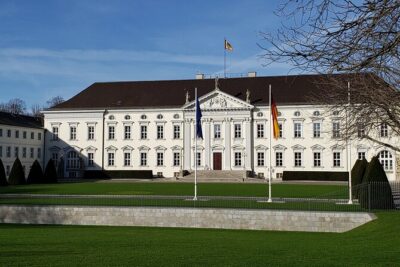
Further along, you’ll pass the Federal Chancellery, the center of support for the Federal Chancellor. The current building has been in use since 2001, designed by Axel Schultes, and it faces a central square opposite the Paul-Löbe-Haus. From the water, you’ll see how the architecture frames the river rather than turning away from it.
A striking contrast comes with the House of World Cultures (HKW), an exhibition and forum for international contemporary art and discourse. The building is known in Berlin’s slang as the “Pregnant Oyster,” and it began in March 1989 in the former congress hall on the Spree. From the cruise, it’s one of the easier places to recognize because it doesn’t try to look like the other government blocks.
If your goal is to understand Berlin’s identity after reunification, these are the stops that say the city is still arguing with itself—just in public.
Palace of Tears and Weidendammer Bridge: Cold War edges you can feel
One of the most quietly powerful stops in the route is the Palace of Tears, the former departure hall at the border crossing point Bahnhof Friedrichstraße. It’s a nickname tied to the idea that East Germans said goodbye to western visitors in tears, while their own travel freedom was restricted.
What makes this section hit is the context of how the space worked: you can connect the building’s role to the physical reality of the border—check-in counters, border staff, and the emotional weight of movement being permitted or not.
Not far away you pass the Weidendammer Bridge, crossing Friedrichstraße over the Spree. The bridge marks the third oldest crossing in the area of old Berlin’s city center. Even if you don’t stop on land, seeing it from the cruise helps you understand how the border-era city and the modern city overlap in the same few meters of river space.
Wrapping up near Bode Museum: ending on UNESCO-level art ambition
The cruise ultimately circles back toward the Museum Island orbit again, including the Bode Museum. It’s part of the Museum Island UNESCO World Heritage ensemble, built in neo-baroque style as the Kaiser Friedrich Museum, originally 1898–1904 by Ernst von Ihne.
Bode Museum is home to the Sculpture Collection, Museum of Byzantine Art, and the Coin Cabinet. If you’re an art person, you’ll likely want to follow up after the cruise. If you’re more of a buildings-and-meaning person, you’ll still appreciate seeing how monumental this museum area is when framed by the river.
You also get a last reminder that Berlin is best understood as a set of connected systems: architecture, politics, art, and the water that keeps everything in reach.
Price and value: when 36.04 makes sense
At $36.04 per person for about 2 hours 30 minutes, this cruise lives in the sweet spot between quick orientation and a half-day commitment. It’s not the cheapest way to see Berlin, but you’re buying time and context.
Here’s why it can feel like good value:
- You get more sights than the 1-hour options, and the route pushes farther along the Spree
- You get a real story thread with live English/German narration
- You hit high-impact zones like the East Side Gallery and the government district without walking the full distance
Where the price can feel less justified is when your biggest interest is only one narrow theme (for example, if you want deep historical episodes with a lot of land time, a cruise can feel broad rather than deep). If you want a “see it all once, then choose what to revisit” plan, this fits nicely.
Should you book this Berlin East Side cruise?
Book it if you want a chill afternoon that still teaches you something, and you like seeing Berlin from the river where bridges and monuments line up in one sweep. It’s especially worth it if you’ll struggle to connect the Wall story, Museum Island, and government landmarks on foot.
Skip (or at least be picky) if you know you struggle with tight seating, heat on board, or you rely on perfect audio from the top deck. In that case, plan your seat choice early and wear layers so you’re comfortable both inside and out.
Bottom line: if the idea of mixing Wall art, museum-block scale, and parliamentary Germany in one river ride appeals to you, this is a strong pick.
FAQ
How long is the cruise?
It lasts about 2 hours 30 minutes.
What language is the commentary?
The tour offers live commentary in English and German.
Where do I meet the tour?
You meet at Anlegestelle Alte Börse / BWSG Berliner Wassersport und Service GmbH, Burgstraße 27, 10178 Berlin.
What time does the tour start?
The listed start time is 2:45 pm.
Is there anything to buy onboard?
Yes. There’s an onboard bar where food and drinks are available for your own expense.
Can I cancel for a refund?
Yes. You can cancel up to 24 hours in advance for a full refund.