REVIEW · BERLIN
Historic center of Berlin – Tour in Italian
Book on Viator →Operated by Vive Berlin Tours · Bookable on Viator
Berlin in 3.5 hours feels like speed-reading history. This Italian-speaking guided walk strings together the Berlin Wall story, the Cold War divide, and key sites of Nazi memory into one route. I especially like the guide’s clear explanations and on-the-ground context, and you’ll appreciate the small-group feel with a max of 28 people. The only drawback is the pace: most stops are brief, so you’ll need to choose what you want to linger over after the tour.
You start at Potsdamer Platz (Potsdamer Platz 10), then move through central Berlin’s most recognizable landmarks, ending near Museum Island at the Pergamon Museum. Along the way, you get a mix of dramatic places (Checkpoint Charlie, Topography of Terror, the Holocaust Memorial) and classic “photo-stop” Berlin (Brandenburg Gate, Unter den Linden). You also get a practical finish: the guide explains how to continue exploring the area on your own.
If you hate walking in mixed weather, plan for it. The tour runs in all weather, so dress for wind and cold, and wear shoes that handle cobblestones and city sidewalks.
In This Review
- Key highlights worth your attention
- Price and timing: what $27.91 buys you
- Starting at Potsdamer Platz: the tour’s fastest way to get oriented
- Wall and Cold War landmarks: Berlin as a divided city
- Topography of Terror
- Checkpoint Charlie
- The aviation ministry building
- Nazi last days and Holocaust remembrance: heavy places handled on foot
- Fuhrerbunker
- Holocaust Memorial (Memorial to the Murdered Jews of Europe)
- Neue Wache
- From Parliament to royal Berlin: Brandenburg Gate, Reichstag, and Unter den Linden
- Reichstag Building (outside only)
- Brandenburg Gate
- Unter den Linden
- Book burning, Humboldt University, and Berlin’s education culture
- Bebelplatz and the book burning memorial
- Humboldt University
- Berliner Dom, Museum Island, and finishing at Pergamon Museum
- Neue Wache to Berliner Dom
- Museum Island finish: UNESCO in your last walk
- Who this tour is best for (and who might want something else)
- Should you book this tour?
- FAQ
- Is the tour guided in Italian?
- How long is the walking tour?
- Where does the tour start and where does it end?
- What’s the group size limit?
- Do I need tickets for the stops?
- What is included in the price?
- What should I bring for weather?
- Do I get a mobile ticket?
- Is the tour mostly outdoors?
Key highlights worth your attention
- Italian guides with real names in the mix: you may be led by guides such as Paolo, Giulia, Fabio, Chiara, Elena, or Daniele, and the recurring theme is strong preparation and clear storytelling.
- A timeline route that makes the landmarks make sense: you’ll link sites from Potsdamer Platz through the Cold War, then into Nazi-era remembrance, and out toward Museum Island.
- Most stops are external or low-friction: even when the subject is heavy, the tour keeps moving so you see more without buying a stack of separate entries.
- Memorials treated with care: Topography of Terror and the Holocaust Memorial are handled as places to understand, not just to pose.
- An easy start and a useful finish: the meeting point is near S/U-Bahn Potsdamer Platz, and the end at Pergamon Museum helps you plan the rest of your day.
Price and timing: what $27.91 buys you
At about $27.91 per person for roughly 3 hours 30 minutes, this tour is priced like a focused city introduction rather than a museum-heavy day. That matters in Berlin, where many major sites are spread out and public transit can be a puzzle on your first day.
Here’s the value angle: you’re paying for an Italian-speaking guide, plus local taxes and the time it takes to connect the “what happened” to the “why it’s here.” You’re also not stuck in a long queue for a single attraction. Most stops are arranged so you can learn quickly on foot and keep moving.
One small planning note: it’s a walking tour. Even with short stop times, you should expect steady movement in central Berlin for most of the day’s middle stretch.
You can also read our reviews of more historical tours in Berlin
Starting at Potsdamer Platz: the tour’s fastest way to get oriented
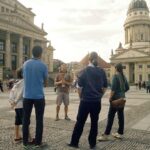
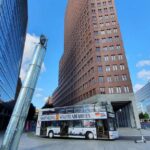
The meeting point is Potsdamer Platz 10, near S/U-Bahn Potsdamer Platz. Look for the blue bicycle by VIVE BERLIN TOURS and a flag with their logo. That simple “find us here” detail can save you stress, especially when you’re juggling schedules and transit.
Potsdamer Platz is a good place to begin because it sits right in the crosshairs of Berlin’s 20th-century story: it’s central, it’s well-known, and it’s a perfect anchor for the guide’s timeline. In the first stretch, your guide sets up how the city changed—politically and physically—and what you’ll be looking for as you walk.
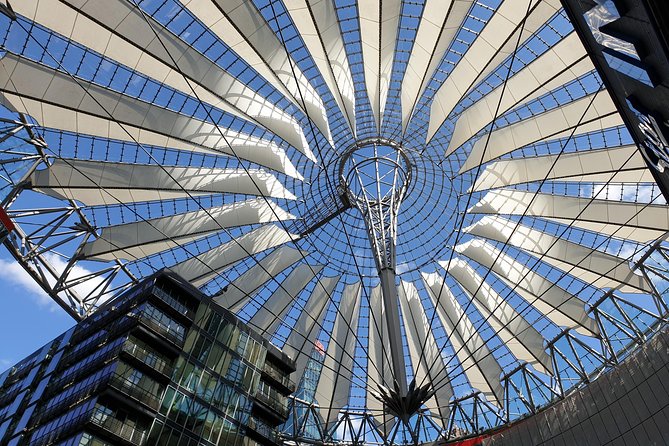
Then comes Sony Center. You might expect a modern complex, and you get one, but what’s interesting is how remnants from the damaged area are preserved and worked into today’s architecture. It’s a smart early contrast: modern Berlin built on top of wartime scars.
Wall and Cold War landmarks: Berlin as a divided city
Once you’re through Potsdamer Platz and the Sony Center area, the tour shifts from “Berlin looks like Berlin” to “Berlin has layers under your feet.”
Topography of Terror
Topography of Terror is one of the most important stops on the walk. The guide explains how the Nazi dictatorship is remembered today and points to where the Gestapo and SS headquarters were located. Even if you don’t go into any interior exhibits, the meaning of the site is the point: it gives you historical coordinates for everything else you’ll see later.
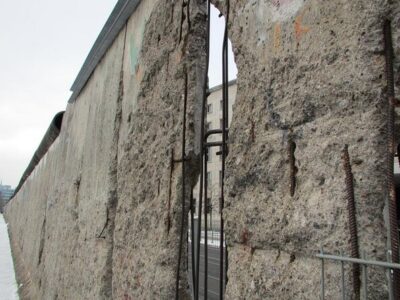
You’ll also have a strong view of nearby structures tied to the Nazi era, including the former Nazi aviation ministry area and an original segment of the Berlin Wall. That wall fragment matters because it’s the Cold War’s physical proof in a city that otherwise constantly reinvented itself.
Checkpoint Charlie
Next is Checkpoint Charlie, a hotspot during the Cold War when the border was a living, daily reality. Your guide connects the construction of the Berlin Wall to the city’s division under communist rule. This is a stop where the context turns a famous name into something you can actually picture.


The aviation ministry building
The stop for the Aviation Ministry of Berlin (a huge, imposing building) is a lesson in how regimes use architecture. It was built by the Nazi dictatorship for the Ministry of Aviation led by Goering. During the Cold War, it became part of the “home of the ministries” for the communist dictatorship. Today, it’s used by the Federal Republic of Germany.
That’s an important theme for Berlin: power changes, and the buildings often outlast it. You learn to read the stone as part of the story, not just as a backdrop.
Nazi last days and Holocaust remembrance: heavy places handled on foot
Some tours treat memory sites like photo opportunities. This one keeps things moving, but the stops themselves are clearly framed to help you understand what happened and why these locations matter.
Fuhrerbunker
At the Fuhrerbunker site, your guide explains what it means that this was where Hitler spent his last days. You don’t need extra background to grasp why Berlin keeps returning to this location, but you do benefit from the explanation of why the site’s present meaning is complicated and worth acknowledging carefully.
Holocaust Memorial (Memorial to the Murdered Jews of Europe)
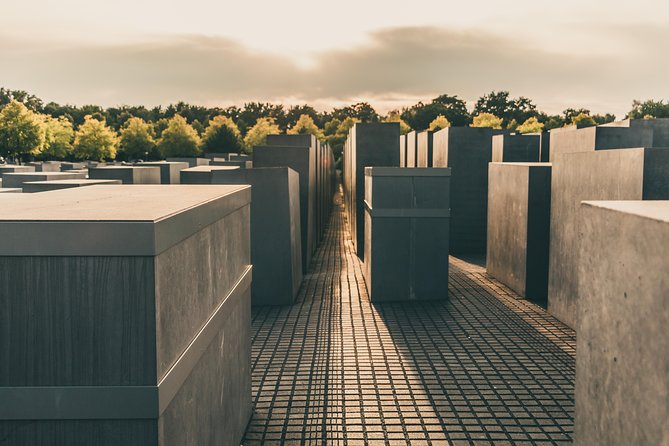
Then you reach The Holocaust Memorial. This is one of the emotionally intense points of the itinerary, and the guide’s job here is to tell stories with weight. The memorial is presented as a symbol in Berlin to remember the greatest crime committed by the German state during Nazism.
This stop is short, but don’t treat it like a quick walk-through. If you want something more than the route provides, give yourself a minute after the tour to come back and read slowly on your own.
Neue Wache
The walk continues to Neue Wache, described as a memorial rejecting war and its horrors. It features a mother crying over her son, a soldier who fell in battle. Again, time on this stop is brief, but it’s a powerful counterpoint to the more political sites you saw earlier.
From Parliament to royal Berlin: Brandenburg Gate, Reichstag, and Unter den Linden
After the memory-heavy stretch, the tour moves into Berlin’s landmark zone—still political, but in a different way: symbolism, governance, and public space.
Reichstag Building (outside only)
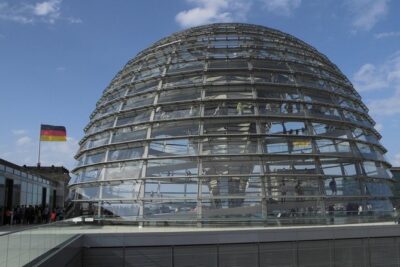
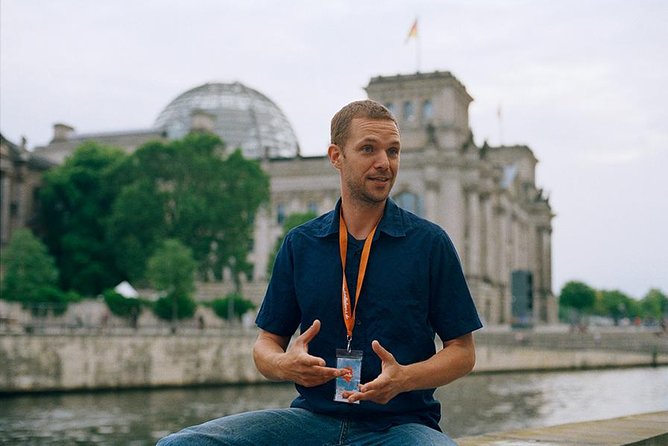
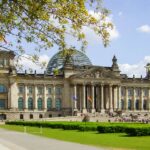
You’ll see the Reichstag Building, the seat of the German Parliament, but you only visit outside. The guide explains how to book a visit to the dome, which is useful because the dome visit is a different experience than standing in the square and looking up at the building.
If you’re the type who likes to take your time with architecture, keep this in mind: the tour’s outside look sets the stage, but you’ll likely want to add the dome visit separately if your schedule allows.
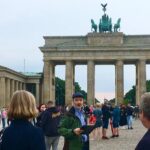
Brandenburg Gate
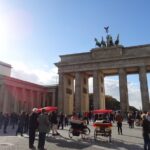
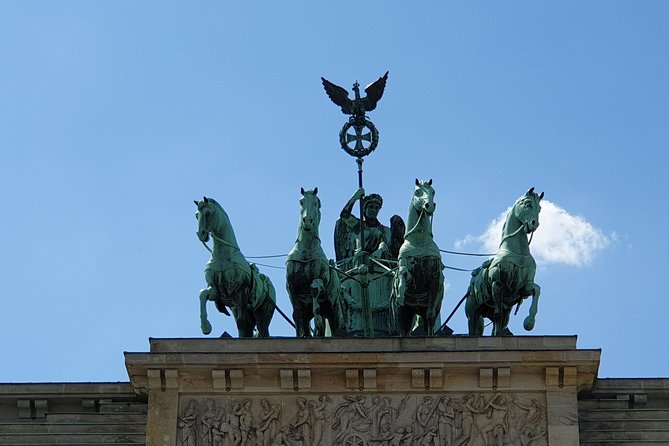
The Brandenburg Gate is the tour’s most famous “you can’t miss it” landmark. It’s introduced as a story-changing gateway: from the symbol of a king’s strength to one of the Cold War, then finally a symbol tied to German reunification.
This stop is also where you’ll probably take the most photos. Still, the guide’s job is to keep it from becoming just a postcard. If you listen, you’ll understand why the gate’s image keeps returning in major moments of modern German history.
Unter den Linden
You walk through Unter den Linden, the great avenue once serving as an access road to the emperor’s palace. Your guide points out how you can recognize different periods of construction—and how the war left wounds you can still see. This is where the tour earns its value as more than a list: you learn how to look.
Book burning, Humboldt University, and Berlin’s education culture
Berlin’s Nazi-era propaganda shows up in more than concentration and border sites. It also shows up in culture and control of ideas.
Bebelplatz and the book burning memorial
At Bebelplatz, your guide ties together two stories: the burning of books during the Nazi dictatorship and the square’s connection to the Humboldt University area and the nearby Catholic Cathedral. Then you reach the Book Burning Memorial at Bebelplatz, which is placed in the center of the square as a reminder of that propaganda action.
Even if you already know the idea of book burnings, seeing it tied to the exact civic space where it happened helps it land with more force.
Humboldt University
Next is Humboldt University. You get a short orientation to the university’s history and who its most famous students have been. With just a few minutes, this stop won’t turn you into a scholar, but it gives you a meaningful cultural layer to carry while you keep exploring.
Berliner Dom, Museum Island, and finishing at Pergamon Museum
The last portion of the route leans toward big architecture and the “Germany you see on postcards” side of Berlin—without losing the fact that modern Berlin was built through massive disruption.
Neue Wache to Berliner Dom
After the memorial stop at Neue Wache, the route continues toward Berliner Dom. It’s described as an impressive church built in the idea of the emperor who wanted something comparable to St. Peter’s for the Lutheran religion. It’s a good place to reorient your eyes after the solemn stops: the building’s scale helps you feel how Berlin projects national identity through monumental design.
Museum Island finish: UNESCO in your last walk
The tour ends at Museum Island, a UNESCO World Heritage Site. Your guide finishes in this area and gives directions for how to continue visiting the city in the best order for your time.
The endpoint is listed as near the Pergamon Museum (Bodestraße 1-3), which is a smart choice for many people. You can finish, then decide whether to go straight into Pergamon, or build your evening around the rest of Museum Island.
Who this tour is best for (and who might want something else)
This tour fits best if you want a first-day structure to Berlin’s big themes. If you like history you can see, and you want an Italian guide to connect the dots, you’ll likely enjoy it.
It also works well if you:
- Speak Italian or prefer Italian-speaking commentary
- Want a compact introduction to Cold War and Nazi-era memory sites
- Like walking but don’t want to plan a whole day of routing and transit
It may not fit you as well if you:
- Want deep time inside fewer museums (this tour keeps stops short)
- Prefer quiet, unstructured wandering over guided pacing
Should you book this tour?
If you’re visiting Berlin for the first time, or you want a guided way to understand why the city looks the way it does, I think this is a solid choice. The price-to-time ratio is fair for a 3.5-hour guided route, and the focus on the most consequential landmarks helps you avoid the common problem of seeing sights without understanding what shaped them.
My call: book it if you want context fast and you’re okay with a route that moves. If you’re planning to spend most of your trip in museums, you may still want this tour as your “why,” then follow up with longer museum visits afterward.
FAQ
Is the tour guided in Italian?
Yes. The tour includes an Italian-speaking guide.
How long is the walking tour?
It lasts about 3 hours 30 minutes.
Where does the tour start and where does it end?
It starts at Potsdamer Platz 10, 10785 Berlin, and ends near Pergamon Museum, Bodestraße 1-3, 10178 Berlin.
What’s the group size limit?
The tour has a maximum of 28 travelers.
Do I need tickets for the stops?
The tour information lists admission ticket as free for the stops described, but it does not include food and drinks. For the Reichstag dome specifically, the guide explains how to book a visit.
What is included in the price?
Local taxes and the local guide are included.
What should I bring for weather?
The tour operates in all weather conditions, so wear appropriate clothing for the day.
Do I get a mobile ticket?
Yes, the tour uses a mobile ticket.
Is the tour mostly outdoors?
It’s a walking tour through central Berlin with stops at landmarks, so plan for time outside.
If you tell me your travel dates and whether you prefer morning or afternoon activities, I can suggest how to pair this with the rest of your Berlin day around Museum Island and the Reichstag area.