REVIEW · BERLIN
In Search of Jewish Berlin Walking Tour
Book on Viator →Operated by Insight Cities · Bookable on Viator
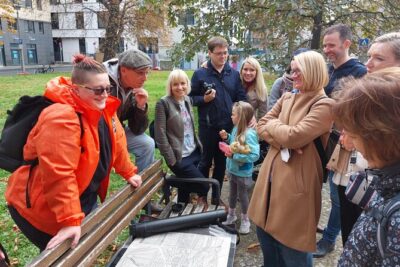
Berlin’s Jewish story is harder and more human. In this small-group walk, you move through the Scheunenviertel with a Jewish history scholar, connecting buildings to real people and real choices. I like how the guide stays empathetic when the material gets heavy, but you should expect quiet, emotional stops, not just pretty photos.
What makes this outing especially worthwhile is the mix of 19th-century Jewish life, 20th-century persecution, and memorial space you actually walk through. You’ll spend time at the New Synagogue, then shift to places tied to education, protest, and the Holocaust, including the Memorial to the Murdered Jews of Europe.
In This Review
- Key things you’ll notice on this walk
- A 3-hour route through Berlin’s Scheunenviertel and major memorials
- Start at Centrum Judaicum: the New Synagogue and Jewish renewal
- Auguststraße 11–13: a Jewish girls’ school in New Objectivity style
- Hackeschen Höfe and the Barn Quarter: where Jewish life took shape
- Block der Frauen: protest from outside the Jewish community
- The Holocaust Memorial: walking Peter Eisenman’s labyrinth of slabs
- Meet your guide: scholar storytelling and real question time
- Price and value: what $156.53 buys you in Berlin
- Timing, pace, and what to wear so you can focus
- Who this tour suits best (and who might want something else)
- Should you book this Jewish Berlin walking tour?
- FAQ
- What is the duration of the tour?
- How much does the tour cost?
- Is the tour offered in English?
- How many people are in the group?
- What is included in the price?
- Are there admission fees for the stops?
- Where does the tour start?
- Can I cancel for a full refund?
Key things you’ll notice on this walk
- Small group size (max 10) means you’re not shouting over the guide and you can ask questions mid-walk.
- English-speaking scholar guidance keeps the facts clear and the tone respectful.
- Scheunenviertel focus helps you understand why this neighborhood mattered for centuries.
- Stop-by-stop free admission at the listed sites keeps the experience moving without surprise ticket hassles.
- Grief turned into architecture at the Holocaust memorial makes you slow down whether you want to or not.
A 3-hour route through Berlin’s Scheunenviertel and major memorials
This tour is about 3 hours at a steady walking pace, built for you to connect dots between sites in central Berlin. The route concentrates on one part of town (the Scheunenviertel, often called the Barn Quarter) while also including two of the most important Holocaust-related stops in Berlin.
The practical upside: you can do it on a typical sightseeing day without losing your whole afternoon. The honest tradeoff: because it touches memorials and deportation history, you’ll want some emotional space afterward. If you’re the type who powers through museums without thinking, this may feel like it keeps asking you to pay attention.
Good news if you like structure: the walk has a clear sequence of stops, and the guide uses the setting to explain how the Jewish community in Berlin changed over time.
You can also read our reviews of more walking tours in Berlin



Start at Centrum Judaicum: the New Synagogue and Jewish renewal
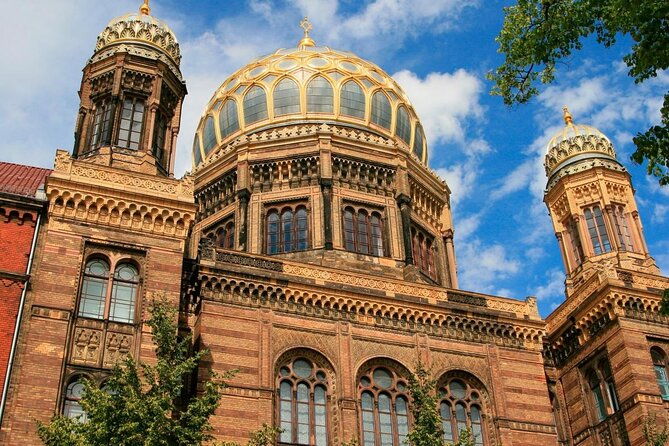
You begin at Stiftung Neue Synagoge Berlin – Centrum Judaicum, the New Synagogue complex. In the 19th century, the building’s grand architecture signaled Jewish assimilation and confidence in public life. That matters, because it gives you a fuller emotional range than a timeline that only focuses on loss.
Today, the same place is home to a Jewish community that is actively reviving in Berlin. That contrast is one of the tour’s smartest moves. It reminds you that history didn’t end when the tragedies began, and it helps you see the synagogue as more than a monument.
You don’t need to plan for paid entry here—the stop includes free admission. You also get time to look at the building closely before the walk shifts to streets and neighborhoods where daily life played out.
Auguststraße 11–13: a Jewish girls’ school in New Objectivity style

Next comes Auguststraße, where you’ll learn about the Jewish Girls’ School built between 1927 and 1928. The school building, at Auguststraße 11–13, is a historical monument designed by architect Alexander Beer and characterized by the New Objectivity style.
What I like about this stop is how it pulls education into the story. It’s easy to jump from synagogue to memorial. This one forces you to think about something more ordinary: classrooms, schedules, and the future being planned by families in the interwar years.
You’ll also have a practical moment here. The building area includes an exhibit hall and a coffee shop that you might find worth stepping into if time allows. Since admission at this stop is free, it’s also a good place to pause without worrying that your ticket budget just got crushed.
Hackeschen Höfe and the Barn Quarter: where Jewish life took shape
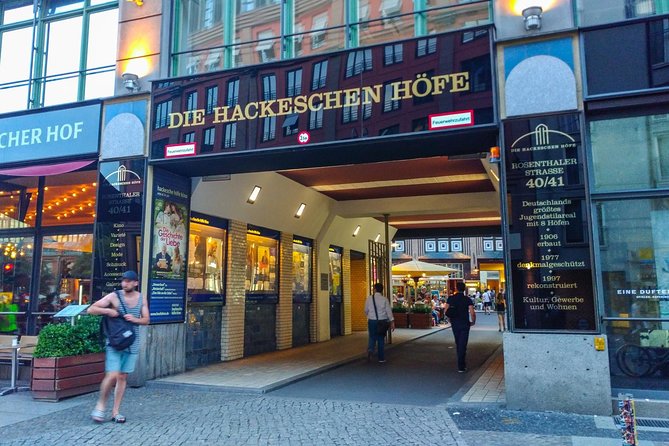
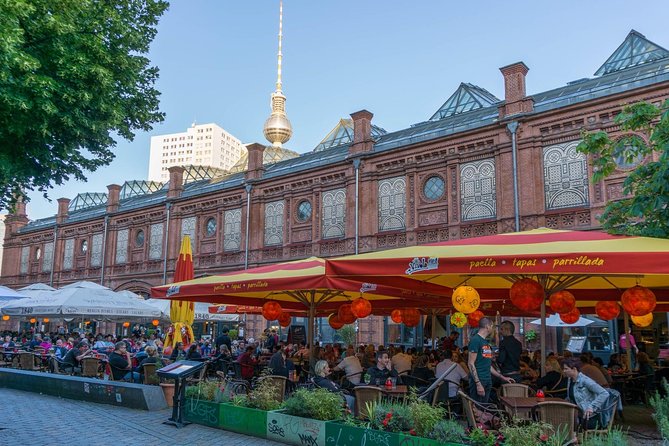
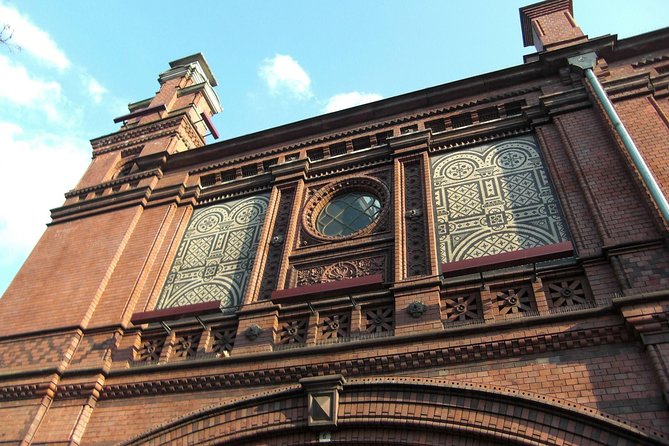
Then you move into Die Hackeschen Hoefe, in the area around Hackescher Markt. This is where the tour’s neighborhood focus pays off. Instead of treating Jewish Berlin as a list of landmark buildings, you get the sense that communities formed around streets, markets, and daily rhythms.
The guide connects the architecture to stories from German Jewish life in the Spandauer Vorstadt and the Scheunenviertel (the Barn Quarter). Even if you’ve never heard these neighborhood names before, the walking format makes them feel real—because you can see the streetscape and not just read about it later.
This stop is scheduled for about 30 minutes, which is long enough to slow down and notice details. It’s also a good chance to ask the guide what to look for on your own afterward, because the neighborhood context helps your later exploration make sense.
Block der Frauen: protest from outside the Jewish community
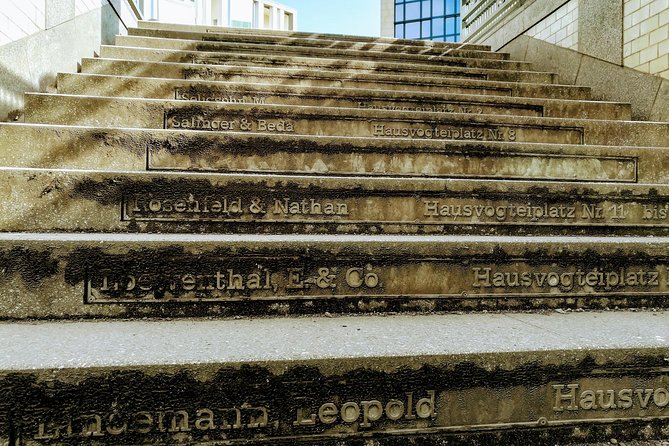
A major pivot comes with Block der Frauen, a memorial tied to sustained protest demonstrations by non-Jewish wives and relatives of Jewish men who had been arrested by the Nazis and targeted for deportation.
This is one of those stops where you’ll feel the difference between remembering victims and remembering people who tried to resist. The tour doesn’t only point at what happened. It points at the human reactions around it—who spoke up, who risked themselves, and what solidarity looked like in real life.
It’s also a short stop (about 20 minutes), so you’ll want to use the time well: look, read, and then ask your guide what the memorial is trying to teach you. If you’re hoping for a purely informative walk with no emotional heaviness, this is where you’ll notice the tone shifts. That emotional shift is also part of why the tour works.





The Holocaust Memorial: walking Peter Eisenman’s labyrinth of slabs
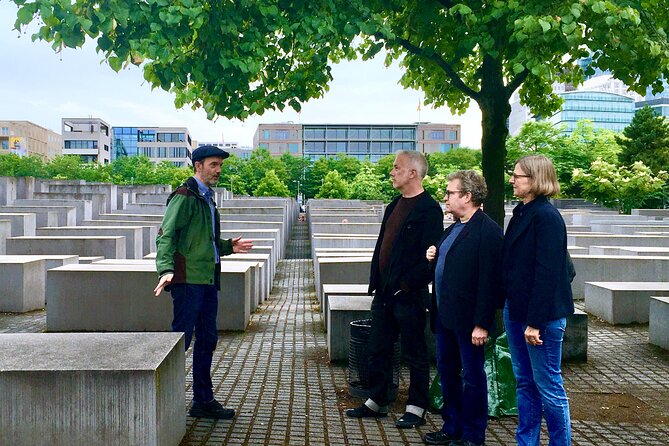
The last major stop is the Memorial to the Murdered Jews of Europe, designed by Peter Eisenman. You’ll pass through 2711 concrete slabs, which are meant to represent Germany’s acknowledgment of the Holocaust.
This is not a stop where the guide tries to turn grief into a lecture. Instead, the structure forces a physical experience—moving between slabs, changing your line of sight, and feeling slightly disoriented in a way that makes the memory feel present rather than distant.
It’s about 20 minutes, and that’s enough time to let your brain catch up to the space. If you’re with someone who wants to take lots of photos, you might gently set a rule for yourselves: look first, take photos second, because the meaning here is in the experience of walking through.
The admission at this stop is free, too, so there’s no extra cost layered on top of an already intense part of the tour.
Meet your guide: scholar storytelling and real question time
This walk is led by a Jewish Studies scholar, and that matters because Jewish history in Berlin is full of dates, terminology, and local place names that can otherwise turn confusing fast. You also get small-group attention, which makes it easier to ask: Why this neighborhood? Why this building? How did one era set up the next?
Guides have included people such as Ioana N., Forrest, Lee, Heather, and Isabel Daniel. The best thing they seem to share is an ability to handle sensitive content with empathy while still explaining clearly. I especially like that some guides are described as willing to answer questions and adjust the walk based on what you care about.
One useful signal from past tours: on at least some dates, the group can get very small—sometimes even just two people. If you want a more conversational pace, that’s the kind of scenario where this format really shines.
If you’re the type who likes to learn with your feet instead of a classroom, you’ll probably enjoy the way the guide connects each location to the bigger story.
Price and value: what $156.53 buys you in Berlin
At $156.53 per person for roughly 3 hours, the price sits in the mid-to-higher range for walking tours. Here’s how I’d judge whether it’s worth it for you:
- You’re paying for a specialist guide (Jewish Studies scholar), not just a general city storyteller.
- You’re getting small-group format with a max of 10 people, which changes the quality of the questions you can ask.
- You visit multiple major sites, and each listed stop includes free admission, so you’re not stacking extra fees on top of the tour price.
There’s also a scheduling hint in the background: this tour is often booked well ahead (an average booking window of 66 days). That usually means you should plan to reserve early if your dates are fixed.
Value is personal, of course. If you only want a quick overview with zero emotional weight, it might feel pricey. If you want context you can carry with you when you wander Berlin afterward, the cost starts to make more sense.
Timing, pace, and what to wear so you can focus
The walk is designed as a normal sightseeing outing: you should be comfortable walking for close to three hours with several short stops. Most travelers can participate, but you’ll still want to wear shoes you trust. Berlin sidewalks can be uneven, and during memorial stops you may end up slowing down more than planned.
Bring a bottle of water if you tend to get dry while walking. Food and drinks aren’t included, so if you’re the planner type, you’ll want to line up a meal before or after.
Because the tour includes emotional memorial spaces, consider how you handle concentration. If you know you tune out during heavy content, bring a notepad and write down one or two questions per stop. That way you stay engaged without feeling like you have to memorize everything.
Who this tour suits best (and who might want something else)
This is a strong pick if you want:
- a guided look at Jewish Berlin that connects streets and buildings to lived experience
- a walk led by a scholar who can explain context and answer questions
- a small group format where you’re not stuck at the back of the crowd
It might be less ideal if you:
- want a purely light, entertainment-style city walk
- dislike memorial spaces and would prefer to explore those sites independently at your own pace
- need a very flexible stop-by-stop itinerary beyond the planned timeline
Should you book this Jewish Berlin walking tour?
If your trip to Berlin includes time for deep context, I’d book this. The mix of the New Synagogue’s history, education on Auguststraße, neighborhood clues in the Hackeschen Hoefe area, and then the memorial-focused stops makes the walk feel like a coherent story, not a random landmark march.
The biggest decision is your emotional readiness. If you can handle heavy themes with care—and you want a guide who treats the topic respectfully—this tour is one of the better ways to understand Jewish Berlin in a few hours without getting lost in facts.
One more practical reason to choose it: since stops listed are free admission, you’re paying mainly for time with a specialist and the small-group attention. That’s where your money goes, and it shows.
FAQ
What is the duration of the tour?
It runs for about 3 hours.
How much does the tour cost?
The price is $156.53 per person.
Is the tour offered in English?
Yes. The tour is offered in English.
How many people are in the group?
This experience has a maximum of 10 travelers.
What is included in the price?
The price includes a 3-hour tour of Berlin with a Jewish studies scholar.
Are there admission fees for the stops?
For the stops listed (including the New Synagogue/Centrum Judaicum and the Holocaust Memorial), admission is listed as free.
Where does the tour start?
The meeting point is Rosenthaler Str. 40/41, 10178 Berlin, Germany.
Can I cancel for a full refund?
Yes. You can cancel up to 24 hours in advance for a full refund.