REVIEW · BERLIN
Private Taxi Tour City East & West History and Architecture 3-4h
Book on Viator →Operated by Gunter Bauer GAT-Productions · Bookable on Viator
Berlin changes fast from one street to the next. This private taxi tour strings together the city’s big East and West stories with close-up stops and clear explanations.
I really like having Gunter drive while I focus on seeing, because Berlin’s layout can feel like a maze when you’re on your own. I also like the mix of iconic places and under-the-radar context, from memorial churches to power buildings.
What I like most is the way the route connects buildings to real decisions—war, rebuilding, politics, and everyday life. The stops are paced so you get time to look up at facades, then get back into the warm taxi for the next leg.
One drawback to flag: it’s a highlights-style ride, so if you want lots of long museum time at every stop, you’ll still need extra visits after.
In This Review
- Key Things That Make This Tour Worth Your Time
- Private Taxi, Real Berlin: Why 3–4 Hours Works
- Driving With Gunter: The Difference a Private Guide Makes
- Kaiser Wilhelm Memorial Church: War, Preservation, and a Strange Name
- Berlin Zoo and the Animal-World Facts You’ll Actually Remember
- Ku’damm and Western Splendor: From Champs Élysées Dreams to Modern Flagships
- KaDeWe and the Art of the Gourmet Stop
- From Pregnant Oyster to Bellevue: Berlin’s Rebuilding Mood Swings
- Reichstag and the Glass Dome: How Parliament Became a View
- Brandenburg Gate and the Pariser Platz Stories That Explain the City
- Gendarmenmarkt and the Two Cathedrals That Aren’t Cathedrals
- Unter den Linden and the Royal Courtyard Feel
- Humboldt Forum: A Palace Reborn for Non-European Collections
- Nikolaiviertel and the Reconstructions That Explain Old Berlin
- East Berlin Atmosphere: Hackesche Höfe to Jewish Berlin Storytelling
- Cold War Reality Check: Checkpoint Charlie (Replica) and Topography of Terror
- Berlin’s Waterways, Embassies, and the City’s Built Logic
- Zoo, Parks, and the Berlin You Can Breathe
- So, Is It Good Value at $150.18 Per Person?
- Should You Book This Private Taxi Tour?
- FAQ
- How long is the private taxi tour?
- What does it cost per person?
- Is pickup included?
- What language is the tour offered in?
- Is this a private tour?
- Do I get WiFi and air-conditioning in the taxi?
- Are any museum or attraction admissions included?
- Is there a group discount?
- Can I bring a service animal or travel with small children?
- Can I cancel for a full refund?
Key Things That Make This Tour Worth Your Time

- Private taxi comfort with an air-conditioned ride and WiFi on board, plus hotel pickup within the S-Bahn ring
- Guided access to major East/West anchors, including Reichstag glass dome, Brandenburg Gate, Humboldt Forum, and Checkpoint Charlie
- A guide who works your interests into the day (Gunter often emails ahead, and he’s happy to answer questions as you go)
- Smart stopping points at places that are either free or quick, so the tour stays efficient in 3–4 hours
- Photo-friendly route with multiple viewpoints, including memorial churches, government buildings, and major squares
- Some admissions are covered (for example KaDeWe is listed as free, and Humboldt Forum is included)
Private Taxi, Real Berlin: Why 3–4 Hours Works

Berlin is famous for history, but the tricky part is distance. A taxi route solves the main problem: you can cover a lot of geography without spending your day hopping between stations and trusting your sense of direction.
In this tour format, you’re not just watching landmarks from afar. You get multiple close-up moments—church portals, grand boulevards, parliament viewpoints—then short taxi rides that let you keep momentum. It’s especially helpful when the weather isn’t cooperating, since you can stay comfortable while still doing real sightseeing.
You can also read our reviews of more city tours in Berlin

Driving With Gunter: The Difference a Private Guide Makes

This is a private tour with Gunter Bauer (GAT-Productions) driving and guiding in English. The biggest value isn’t just the facts—it’s how he keeps the story tied to what you’re actually looking at right now.
From the reviews, you can also expect a guide who communicates and adapts. People wrote that Gunter emailed ahead to understand interests, rescheduled when travel delays popped up, and made sure older guests stayed comfortable. I’d treat this as a tour where you can ask follow-ups—why a building looks the way it does, what was rebuilt, what political choices changed the city’s shape.
He also takes photos for you during stops and shares them afterward, which is a nice bonus when you want a few polished memories of places like Brandenburg Gate and Humboldt Forum without juggling your phone the whole time.
Kaiser Wilhelm Memorial Church: War, Preservation, and a Strange Name
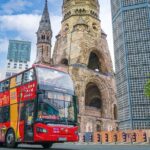
The tour spends real time on the Kaiser Wilhelm Memorial Church, and it makes sense. The church is one of those Berlin locations where you can stand in front of damage and still see the logic behind the rebuilding.
From one side, you get the story of a memorial that some people confuse as war remembrance. The preserved portal and faces connect to the Prussian royal world—wildly specific for a church entrance, and a great reminder that symbolism often starts with power. You’ll also hear why the war-torn place wasn’t fully cleared: there was resistance, so parts like the tower and west portal remain.
Later, you see the church from another angle. The modern structure gets its look from thousands of glass stones made in France, which turns the interior into a quiet blue-light experience. There’s also a practical reason it feels calmer than you’d expect: a double wall with a soundproofing air space. The tradeoff is structural fragility—scaffolding can be part of the scene near major roads.
Berlin Zoo and the Animal-World Facts You’ll Actually Remember

Berlin Zoo isn’t treated like a quick photo stop here. You get a mini lesson that helps you understand why Berlin has multiple zoo-like destinations connected to palace grounds and royal hunting traditions.
The key numbers are huge: about 16,000 animals across 1,600 different species. The foundation story goes back to King Friedrich Wilhelm IV, who moved animals near Berlin after earlier arrangements on Pfaueninsel didn’t work well. The zoo’s buildings were also designed in styles inspired by the animals’ countries of origin, and that detail is still visible even with war damage.
Two exterior features are called out as especially striking: the elephant gate and the lion gate near the Zoo station. One smart reality check: Berlin has another zoo associated with Friedrichsfelde Palace, and the tour connects the idea that the two are now part of a shared larger system. If you’re a zoo person, this background makes the place feel less random.
Ku’damm and Western Splendor: From Champs Élysées Dreams to Modern Flagships

The tour threads through the big West Berlin shopping-and-style axis, including Kantstraße into Kurfürstendamm (Ku’damm) and then the longer stretch toward Halensee.
You’ll hear how Ku’damm was modeled after Paris’s Champs Élysées, and even the candelabra references that political admiration after Germany’s victory. The boulevard today has less old-villa romance and more boutique and flagship retail—places like Apple and Tesla show up here—so at night it can feel quieter than you’d expect for a place with this much fame.
This is one of the tour stops where I think the taxi format shines. You can look down the boulevard and get the “this is a whole corridor” feeling without walking five kilometers. Then you’re ready for the next architectural pivot—church, shopping center, and formal old-West monuments.
You can also read our reviews of more private tours in Berlin


KaDeWe and the Art of the Gourmet Stop

One of the most practical stops is KaDeWe (Kaufhaus des Westens) on the Tauentzien stretch. The tour frames it like a quick but high-reward “Berlin taste test.”
KaDeWe is described as the largest single department store in continental Europe, with around 60,000 m². The standout floor for visitors is the gourmet level, where the range is the whole point—champagne-style indulgence, oysters, and lots of bread and cheese choices.
It’s listed as a short stop, and the entry ticket is noted as free on the schedule. That makes it a strong value pick: you can walk through, get a feel for the place, and still keep your day on track.
From Pregnant Oyster to Bellevue: Berlin’s Rebuilding Mood Swings

A big chunk of the tour is about what happens after destruction. That theme shows up from multiple angles.
You’ll visit the former congress hall nicknamed the Pregnant Oyster—now the House of World Cultures. The Americans gifted the building idea in the 1950s, and the curved roof is the reason for the nickname. You’ll also hear the hard part of modern ambition: the roof collapsed in 1980 after structural limits, and the hall was rebuilt true to the original.
From there, the tour shifts to Berlin’s political seating: Schloss Bellevue, described as the small castle built for August Ferdinand. The view politics story is important—East Berlin protests connected to the idea of West Berlin being treated like a neutral bloc. After reunification, the building’s role solidified as the federal seat.
Reichstag and the Glass Dome: How Parliament Became a View

The tour’s parliament section is built for people who like seeing how a country organizes itself. You’ll go to the Reichstag and then the “engine” where day-to-day work happens.
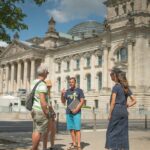
The Reichstag’s modern meaning comes from layers: a historical building that was hard to use during division, then rebuilt after reunification. You’ll also hear how a Christo wrapping action became part of the story, and how the dome and glass roof represent the newer Berlin.
Then you get the practical explanation: Parliament discussions and voting aren’t simply held in the public dome area. Committees do the real work, and you can view parliamentary activity from outside perspectives created by the building design. It’s a “you’ll see it for what it is, not what you imagine” moment, which I appreciate.
If you like government buildings, you’ll also see the Chancellor’s Office described as a huge office complex with about 500 rooms and 10 floors, plus a rotunda and an official apartment that isn’t used by the Chancellor. You then continue to a modern press-facing building with a large window, where accredited journalists watch from inside a blue-wall set-up a couple times per week.
Brandenburg Gate and the Pariser Platz Stories That Explain the City
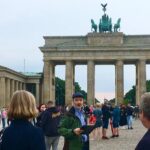
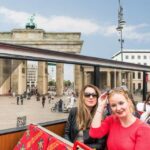
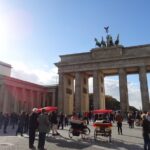
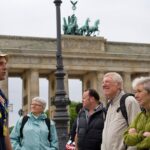
Berlin’s central “parlor” moment is the Brandenburg Gate. The tour places it at Pariser Platz and frames the gate as the surviving remnant of a wider pre-war setting. After war and demolition, the gate became isolated like Paris’s Arc de Triomphe, and it wasn’t planned that way—block walls and separation kept the gate from being the city’s open meeting point.
You also get the East/West geometry: thick walls from the west, fences and separation from the east, plus the demolition of the Hotel Adlon part of the background. After reunification, the surroundings were rebuilt in modernized style in the same general footprint, including the Academy of the Arts and embassy buildings.
Right nearby is another history lesson: the large former Soviet foreign representation building. The tour explains it was designed to show who was in charge, with an inner courtyard that went against the idea of uniform alignment. Even if you don’t obsess over architectural politics, this stop helps you understand why Berlin’s center still feels like multiple eras stacked on top of each other.
Gendarmenmarkt and the Two Cathedrals That Aren’t Cathedrals
At Gendarmenmarkt, the tour highlights a square that many people consider Berlin’s most beautiful. The point you’ll remember is that the two “cathedrals” are meetinghouses with cathedral-like towers—German and French cathedrals in name, but not bishop seats.
You’ll also hear how Frederick II’s choices created the square’s symmetry, and how the French side ties to Huguenot refugees and a French-language congregation. The German side now includes a museum focused on parliamentary history. This is one of those stops where a little explanation turns the whole square from pretty into meaningful.
Unter den Linden and the Royal Courtyard Feel
The tour also walks you through the logic of Unter den Linden, including how it began as a bridle path linked Berlin Palace to the west and hunting grounds. The name story matters: the planting debate between nut trees and linden trees ended with linden trees, which explains the boulevard’s nickname identity.
Then you’ll see prominent buildings around the square area, including palaces tied to royal births and upbringing. Kronprinzenpalais and Kronprinzessinnenpalais show up as examples of how dynastic life shaped architecture, even when you barely notice their role at first.
Also don’t miss the “mourning” stop: the New Guardhouse area where the traditional changing-of-the-guard spectacle is gone, but the site now focuses on remembrance. The tour describes the sculpture as an enlarged form of Käthe Kollwitz’s Pietà work, originally connected to her son’s early death after the First World War, and it’s now used as a place for wreaths honoring victims of war and tyranny.
Humboldt Forum: A Palace Reborn for Non-European Collections
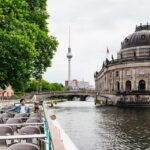
Humboldt Forum is a major stop, and it’s handled with the kind of context that makes the place click. For decades, the site was a parking lot. Then the Berlin Palace—burned out but standing—remained as a silhouette and had partial interior use before the later demolition decision.
The tour’s explanation focuses on documentation and reconstruction: the palace was documented before demolition, enabling a reconstruction that aims to match externally. The Schlüter inner courtyard is also reconstructed. The museum program then connects the palace setting to non-European art collections and Humboldt University material, planned to open in sections.
This is a place where you’ll likely want extra time if you’re a museum person. But even as a quick stop, it’s one of the strongest “why Berlin looks like Berlin” moments on the route.
Nikolaiviertel and the Reconstructions That Explain Old Berlin
The tour makes a point of Nikolaiviertel, where you can get an “old Berlin” feeling fast. The catch is important and honest: the area was reconstructed in the 1980s, and the tour notes that the reality on the ground was limited to a few houses and partial church structure at the time.
You’ll visit the area connected to Nikolaikirche—the oldest church in Berlin, now functioning as a city museum—and then move to Knoblauchhaus, furnished in Biedermeier style with focus on a cloth maker family. This is a great stop if you want a snapshot of daily life rather than just political history.
The food and viewpoint angle matters too. The schedule notes restaurants with views toward the Spree, and the city-style look is part of the appeal.
East Berlin Atmosphere: Hackesche Höfe to Jewish Berlin Storytelling
On the East side, the tour heads to Hackesche Höfe, described as restored Art Nouveau courtyards. You’ll hear the history arc: built as a showcase area in 1908, mixed work and living, then damaged in GDR times and used partly as warehouse space, then restored after the Wall.
What you’ll notice today is the change in function. Workshops are replaced with shops, but some brand-type cultural continuity remains, including KPM porcelain displays and the presence of Ampelmännchen products. If you like design and city texture, Hackesche Höfe is a good way to break up heavy WWII and Cold War themes.
The route also includes Jewish Berlin history. A major synagogue stop is described with Moorish-style elements and a golden dome. The church itself was destroyed in war, and the front portal started being rebuilt in Eastern times. The tour also describes tight security measures at the entrance, and it notes the synagogue was built to replace an older one during Prussia’s era of civil equality, with Bismarck attending in 1866.
This is one of those stops where the taxi makes sense: you get close access without trying to time public transit through a busy central area.
Cold War Reality Check: Checkpoint Charlie (Replica) and Topography of Terror
Two famous Cold War locations show up, but the tour helps you understand the difference between photo landmark and historical evidence.
At Checkpoint Charlie, the tour calls out that what you see is a replica of the US armed forces checkpoint from the 1960s, and that the famous sign shown in photos isn’t original. Still, it points you to what the place represents, including the October 1961 tank confrontation described as a peak moment of the Cold War.
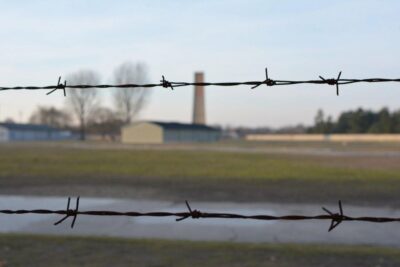
Then you get to Topography of Terror, which is presented as a layered history site. The tour explains multiple eras in one footprint: Imperial/Prussian structures, a major Nazi-era building tied to Göring, uncovered torture cells from excavations in the 1980s, and a preserved section of the Berlin Wall from the divided-city era. It’s a short tour, but the structure makes it feel like Berlin is showing receipts.
Berlin’s Waterways, Embassies, and the City’s Built Logic
I like that the tour doesn’t treat Berlin as only monuments. It also explains why so much of the city follows water.
The route uses the Landwehr Canal as a big orientation tool. You’ll hear the practical background: groundwater is shallow, water was dammed and drained through canals, and Dutch experts helped develop these water systems under the Great Elector. Landwehr Canal had functions including shortening the meandering Spree for navigation, cargo shipping for suburbs, and drainage for swampy areas around places like Kreuzberg and the Tiergarten.
You’ll also see the embassy landscape along a zoo-adjacent corridor, with the tour naming countries and design signals in a way that helps you read facades quickly while you’re moving. The Nordic embassies show up with a “copper-aged” band detail, and then you shift toward major security-conscious buildings like the InterContinental area near Tiergarten.
Zoo, Parks, and the Berlin You Can Breathe
Not every stop is heavy. The tour includes a tucked-away park corner shaped by Peter Lenné, with lakes created to absorb and bundle water before it drains into the canal. The tone here is practical and relaxed: you’ll hear about beer gardens, the Berlin habit of drinking Molle outside, and even options like pedal boating or renting boats.
The scheduling works so you don’t just move from one monument to another. You get a chance to reset your brain and look at the city’s softer side.
So, Is It Good Value at $150.18 Per Person?
For $150.18 per person, you’re buying time, comfort, and a guide who ties architecture to decisions. This isn’t just a bus tour with a script. It’s a private taxi format that covers both East and West highlights in a single half-day window.
Your value improves if you fall into one of these groups:
- You want to see a lot without planning transit.
- You want clear explanations, not just photos.
- You’re visiting in colder months and appreciate staying warm in the car between stops.
- Your group includes people who may not want long museum sprints back-to-back.
The only real tradeoff is selection. In 3–4 hours you can’t do deep museum time at multiple sites. If you want that, use this tour as your compass, then come back for what grabs you most.
Should You Book This Private Taxi Tour?
I’d book it if your goal is to get your bearings fast and still understand why Berlin looks the way it does. The combination of private comfort, a strong guide like Gunter, and tightly chosen stops—churches, government buildings, squares, Cold War sites, and museum anchors—makes it a smart first or second-day plan.
Skip it only if you want hours of indoor museum depth at every location. Otherwise, this taxi route gives you an efficient, human-sized way to see Berlin’s East and West in one connected story.
FAQ
How long is the private taxi tour?
The tour runs about 3 to 4 hours.
What does it cost per person?
The price is listed as $150.18 per person.
Is pickup included?
Yes, pickup is included within the S-Bahn ring. Pickup from BER airport or outside the S-Bahn ring may cost extra.
What language is the tour offered in?
The tour is offered in English.
Is this a private tour?
Yes. It’s private, meaning only your group participates.
Do I get WiFi and air-conditioning in the taxi?
WiFi on board and an air-conditioned vehicle are included.
Are any museum or attraction admissions included?
KaDeWe is listed with an admission ticket free stop. Humboldt Forum is listed as admission ticket included. Several other stops are marked free on the schedule (for example Brandenburg Gate, Gendarmenmarkt, and Topography of Terror).
Is there a group discount?
Group discounts are mentioned as a feature.
Can I bring a service animal or travel with small children?
Service animals are allowed. Child seats are available for toddlers (six months to three years) and booster seats for older children; a baby seat can be brought on request.
Can I cancel for a full refund?
Free cancellation is available up to 24 hours in advance for a full refund.