REVIEW · BERLIN
Private Walking Tour: World War 2 and Cold War Sites in Berlin
Book on Viator →Operated by Insider Tour Berlin · Bookable on Viator
Berlin has layers. This private walk strings them together fast, with WWII and Cold War stops in one coherent route. What I like most is the custom pacing and the way your guide can steer you toward what you care about. I also like that you’re not stuck with a generic script at the big landmarks like the Reichstag and the Brandenburg Gate. One thing to plan for: it’s a lot of walking on days when the weather is cold, rainy, or when the city has events.
You start with a hotel lobby meet-and-greet and then choose your focus—World War II, the Cold War, or a mix. Expect serious, sometimes heavy sites (Hitler’s bunker location, the Holocaust Memorial, Nazi HQs, and the mechanics of division). The payoff is that Berlin stops feeling like random photos and starts feeling like a story with cause and consequence.
In This Review
- Key things that make this tour worth your time
- How the private Berlin walk gets tailored to your WWII vs Cold War interests
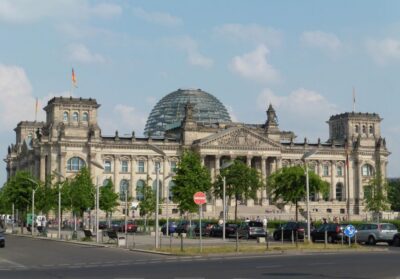
- Start at the Reichstag and Brandenburg Gate: resistance, power, and a city icon
- Holocaust Memorial and Hitler’s bunker area: what you see, what it does to you
- Nazi-era institutions: Reich Air Ministry and Topography of Terror
- Checkpoint Charlie and Tränenpalast: Berlin’s Cold War human timeline
- Bernauer Straße Wall Memorial and the East Side Gallery: division and what survives
- Tempelhofer Feld and Prenzlauer Berg prisons: war aftermath and state control
- Price and logistics: is $192.97 per person good value?
- What to expect on the ground: pacing, breaks, and weather reality
- Who should book this private Berlin WWII and Cold War tour
- Should you book this private WWII and Cold War walking tour?
- FAQ
- FAQ
- How long is the private walking tour?
- Where do we meet the guide?
- Can I choose the focus of the tour?
- Are there hotel pickup and drop-off?
- What language is the tour offered in?
- Is the tour private?
- Are tickets or entry fees included?
- What’s not included in the tour?
- Is a mobile ticket provided?
- Can I cancel for a refund?
Key things that make this tour worth your time
- Private guide, not a lecture: You get one group, your own questions, and room to adjust.
- WWII + Cold War in one route: You connect how the Nazi era set the stage for division later.
- Real Berlin locations, not just viewpoints: Reich Air Ministry, Topography of Terror, Checkpoint Charlie, Bernauer Straße.
- Free admission at most stops: Several major sites on the route list free entry.
- Hotel pickup and drop-off included: You save time and energy on a long, walking-heavy day.
- Multiple guide styles are a good match: I keep seeing the same theme—guides answer questions and keep momentum.
How the private Berlin walk gets tailored to your WWII vs Cold War interests
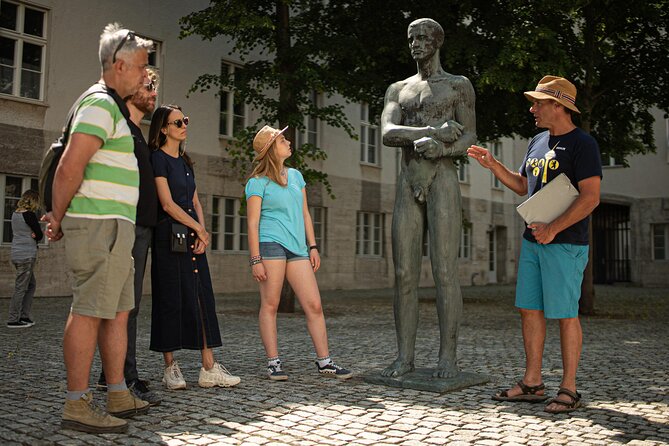
This is a private half-day walking tour in central Berlin, designed around choice. You pick the morning or afternoon departure, then you decide whether to lean into World War II sites, Cold War sites, or blend both. That flexibility matters because Berlin can feel endless if you try to self-drive history day by day.
In practical terms, the guide isn’t just moving you from A to B. They’re also listening for what you want answered: the rise of Hitler, everyday life during the Third Reich, why Berlin became a Cold War symbol, or how escape attempts worked in a city split down the middle. If you’re the type who likes context—why a building matters, what a street used to look like, what a specific standoff meant—you’ll get a lot more out of the walk.
The sensitive side is real. You’ll pass memorials and sites tied to persecution and state terror. If you need shorter stops, a break, or a gentler approach, tell the guide early so the day stays workable.
You can also read our reviews of more walking tours in Berlin


Start at the Reichstag and Brandenburg Gate: resistance, power, and a city icon
You begin at the Reichstag building. Even if you don’t go inside, the area gives you a strong political anchor. This stop sets up a thread from resistance and tragedy to the end of the Third Reich—stories tied to people who opposed the regime and the grim arc from Stalingrad through the Battle of Berlin. You’ll also hear about ideas around Albert Speer’s Germania plans and what Soviet Monumentalism looked like after the war.
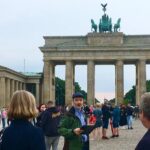
Then you head to the Brandenburg Gate, a landmark that’s easy to recognize but harder to understand without context. During the Cold War it became a symbol of division between East and West Berlin, and today it reads as a national symbol of peace and unity. It’s a good example of why this kind of guided route helps: the same stones, different meanings depending on the year.
One more useful detail: these are classic photo stops, but your guide’s goal is to keep you from treating them like postcards. You’re there to learn how political power shaped space—and how Berlin’s identity changed as control changed.
Holocaust Memorial and Hitler’s bunker area: what you see, what it does to you
Near the Brandenburg Gate is the Memorial to the Murdered Jews of Europe. It’s built from 2,711 concrete slabs arranged in a grid, with varying heights that can make you feel disoriented as you move through it. Beneath the memorial is an underground information center with historical context and personal accounts. This is not the kind of place to rush.
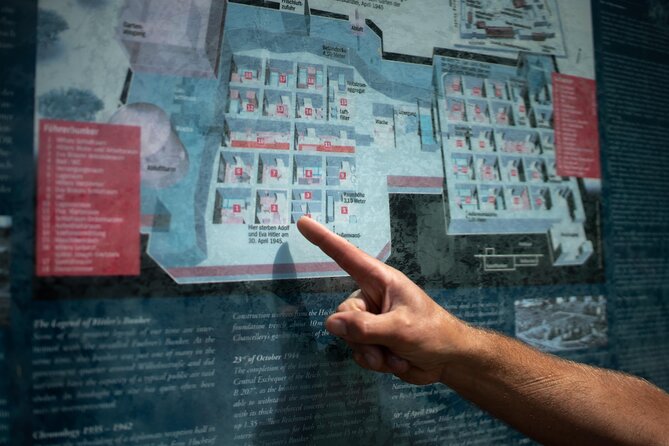
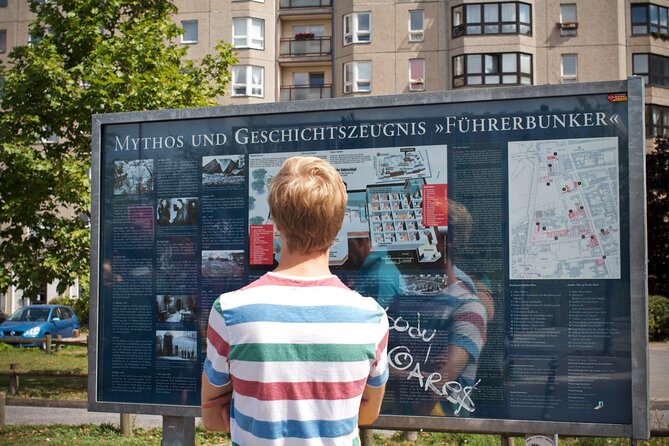
You then move toward the Fuhrerbunker stop—focused on the area where Hitler’s bunker was located. This is heavy subject matter, but it’s also one of the stops that makes Berlin’s WWII history feel close instead of distant. The guide ties the “how we got here” story to what the regime represented and how Berlin was reshaped by those choices.
If you’re taking this early in your trip, this is one of the best places to reset your mental map. After these stops, the rest of the tour hits harder—because you understand what “before” looked like.
Nazi-era institutions: Reich Air Ministry and Topography of Terror
Two of the strongest WWII-related stops are about systems, not just soldiers.
First up is the Aviation Ministry of Berlin, tied to the Reich Air Ministry. Completed in 1936, the massive structure was closely linked with Hermann Göring and served as headquarters connected to the Luftwaffe. Even with war damage, the building survived and was later repurposed by East Germany as the Ministry of Transport. That change of use is a reminder: buildings often outlive the ideology that built them.
Next is Topography of Terror. This location marks where the SS, Gestapo, and the SD had their headquarters. Today, it’s an exhibition focused on the perpetrators and the machinery of terror behind the scenes. You’re looking at the place where intimidation wasn’t theoretical—it was administrative and operational.
The practical value here: if you’ve ever watched WWII documentaries and wondered how power actually functioned on the ground, these stops help connect the dots between leaders, offices, and daily reality.
Checkpoint Charlie and Tränenpalast: Berlin’s Cold War human timeline
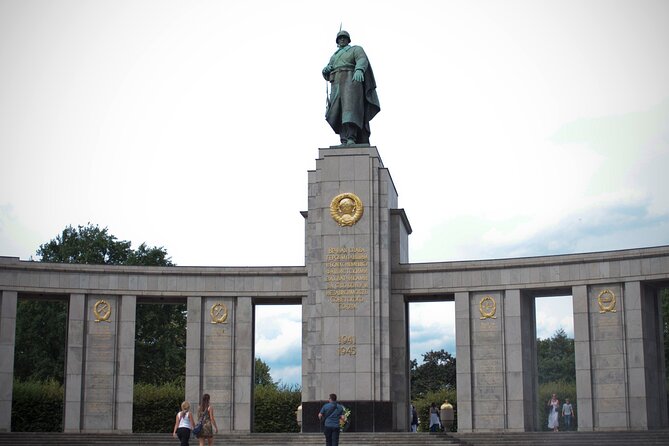
After WWII, the tour switches gears into Cold War logic—borders, rules, and the emotional cost.
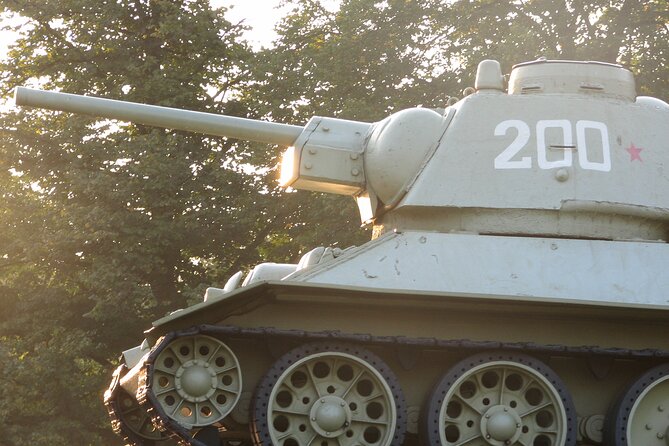
Checkpoint Charlie is the best-known crossing point between East and West Berlin. It’s famous for the 1961 tank standoff between American and Soviet forces, a moment that pushed the world toward the brink of war. On this walk, you’ll hear stories tied to espionage and escape attempts, plus the human cost of separation for families and friends.
Then comes Tränenpalast, the Palace of Tears, at Friedrichstraße station. Between 1961 and 1989, it served as a departure hall for East Germans crossing into West Berlin. Because the Berlin Wall created strict travel restrictions, families were often forced into painful goodbyes—many never seeing each other again. Today, it houses a museum that explores the Berlin Wall era through personal stories.
If you’re trying to understand the Cold War beyond politics, these two stops do it for you. They turn big geopolitical conflict into something you can picture at street level: paperwork, crossings, delays, and heartbreak.
You can also read our reviews of more private tours in Berlin


Bernauer Straße Wall Memorial and the East Side Gallery: division and what survives
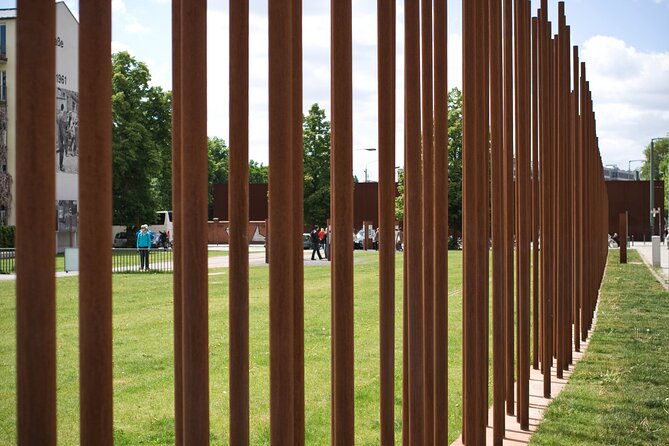
You’ll spend time at the Berlin Wall Memorial on Bernauer Straße. When the Wall was erected in 1961, it split the street in half—trapping East Berlin residents while West Berlin watched from the other side. The area also became known for escape attempts, including Tunnel 29 (built in 1962) and Tunnel 57 (constructed in 1970).
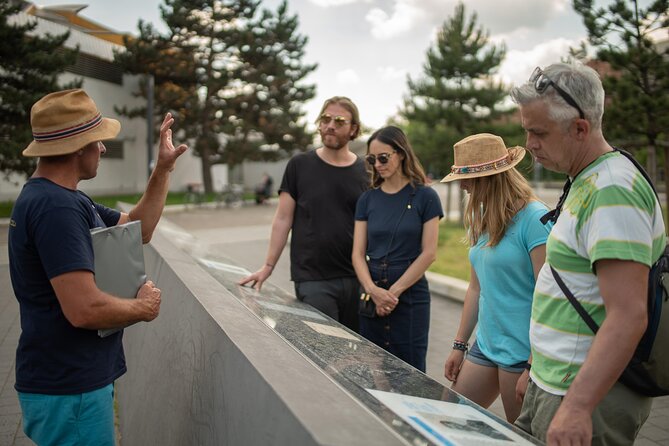
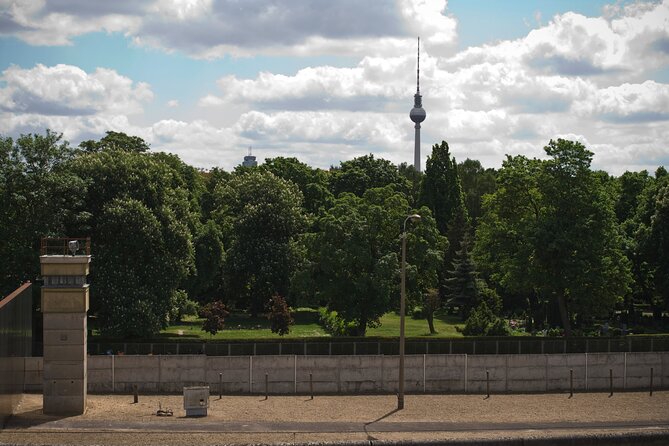
At the memorial, preserved sections of the Wall, a watchtower, and a documentation center show what people tried to do to get free—and what the system did to stop them. This is one of the most emotionally grounded parts of the tour because you see how the Wall affected movement at street level.
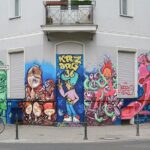
Later, you walk to the East Side Gallery. It’s the longest permanent open-air graffiti wall in the world, and it includes the longest still-standing piece of the Berlin Wall. Here, the tone shifts from oppression to expression: murals promoting justice and freedom. That contrast works well after Bernauer Straße—you leave with both the wound and the response.
Tempelhofer Feld and Prenzlauer Berg prisons: war aftermath and state control
Tempelhofer Feld is a former Nazi airport used by the Allies during the Berlin Airlift in 1948/49. Today it’s not operating as an airport, but it’s a huge public space—often described as an immense playground. This stop works because it adds a third layer: after destruction, Berlin also became a city where survival required logistics and cooperation.
Then you head toward Prenzlauer Berg, linked to an old NKVD prison (a precursor to the KGB). Later, the site was used by East Germany’s secret police, the Stasi. The focus is on methods used to extract information from prisoners, and you’ll also see how the site is used today in Germany’s process of coming to terms with its destructive past.
You end with East Side Gallery on the route as written, but the overall effect is that you’re not only learning dates. You’re seeing how institutions control bodies and movement—first through the Nazi regime, later through Cold War systems.
Price and logistics: is $192.97 per person good value?
At $192.97 per person for a 3 to 4 hour private walk, you’re paying for three things at once: a private guide, hotel pickup and drop-off, and a route that can be customized. That combination matters in Berlin because distances are manageable but history sites are spread, and walking time adds up fast.
Is it worth it? It tends to be, especially if:
- you want WWII and Cold War covered in one shot
- you’re the kind of person who asks questions and wants clear explanations at each stop
- you value not having to plan the order of sites on your own
- you’d rather spend your energy reading the city than finding how to get between it
The one tradeoff is that private pricing can feel steep if you’re traveling solo and comparing against group tours. But you’re getting a guide who can adjust the pace and emphasis, and you’re starting/ending with hotel pickup and drop-off instead of juggling transit for a long day.
What to expect on the ground: pacing, breaks, and weather reality
The tour is built for walking, with short time blocks at each stop. Most stops are listed as free entry, which helps you spend time inside or at the site without ticket friction. Still, you should plan for a full half-day of steps.
I’d also plan for weather. Berlin can be cold and rainy, and long outdoor stretches can slow you down. One smart move: ask your guide to include water breaks early, so you don’t end up racing to fit everything in.
Who should book this private Berlin WWII and Cold War tour
This private route is a strong fit if you:
- want an easy way to connect Nazi-era Berlin to Cold War division
- like structured history but hate feeling trapped in a script
- are traveling with someone who also wants context, not just photos
- want a first-day orientation that makes later self-guided exploring feel smarter
It may be less ideal if you:
- need frequent stops due to mobility or stamina limits (it’s designed as a walking tour)
- prefer lighter topics that avoid Holocaust and terror-related sites
- want a very casual, low-effort sightseeing day (this is story-heavy)
Should you book this private WWII and Cold War walking tour?
If Berlin history is on your must-do list, I’d book it. This is one of those tours where the value comes from interpretation: the guide helps you understand why each location matters, and the private format gives you time to ask and adjust.
Book it if you want both eras covered with a coherent arc, from the Reichstag and Brandenburg Gate through Holocaust remembrance, Nazi-era institutions, and Cold War crossings like Checkpoint Charlie and Tränenpalast. If you’re worried about walking time, tell the guide your pace needs right away so the day stays comfortable.
FAQ
FAQ
How long is the private walking tour?
It runs about 3 to 4 hours.
Where do we meet the guide?
You meet with the guide in a central Berlin hotel lobby for a meet and greet.
Can I choose the focus of the tour?
Yes. You can focus on World War II, the Cold War, or request a combination.
Are there hotel pickup and drop-off?
Yes. Hotel pickup and drop-off are included.
What language is the tour offered in?
The tour is offered in English.
Is the tour private?
Yes. It’s private, so only your group participates.
Are tickets or entry fees included?
Many stops list admission ticket free, and the tour includes the relevant site visits as part of the route.
What’s not included in the tour?
Food and drinks are not included.
Is a mobile ticket provided?
Yes. A mobile ticket is provided.
Can I cancel for a refund?
You can cancel up to 24 hours in advance for a full refund. If you cancel less than 24 hours before the start time, the amount paid is not refunded.