REVIEW · BERLIN
Berlin: Guided Bike Tour to Explore the Highlights
Book on Viator →Operated by FREE BERLIN Bike Tours · Bookable on Viator
Berlin moves fast, and this tour helps you keep up. In just about 3 hours, you glide through key landmarks and learn the why behind them, from divided-city scars to today’s civic pride.
What I like most is the way the ride turns into a guided story you can actually see, not just read. I also love the small-group setup and the built-in pace, with short stops that keep you moving while still giving you time to look closely.
One thing to consider: it’s a highlights loop, so time at each site is limited. If you want long photo sessions or deep museum-style explanations, plan for extra time elsewhere.
In This Review
- Key things to know before you ride
- Getting oriented on Berlin’s highlights in a small-group ride
- Price and what feels like good value at $42.34
- Nikolaiviertel and the TV Tower: starting with Berlin’s staged old-town vibe
- Book Burning Memorial at Bebelplatz: a viewpoint for the city’s power story
- Checkpoint Charlie (English option only) and Potsdamer Platz: the border line and the in-between world
- Memorial to the Murdered Jews of Europe: silent, then back on the move
- Tiergarten break: why a bike tour needs a park pause
- Brandenburg Gate and Reichstag: classic photos with modern meaning
- Museum Island: “Spree Athens” and the architecture quick-hit
- The one detail that can change your tour: Free-Berlin route design
- What to watch for before you book
- Should you book this Berlin bike highlights tour?
- FAQ
- How long is the Berlin guided bike tour?
- What does the tour cost?
- What is included with the bike tour?
- Which languages are available?
- Is Checkpoint Charlie part of every version?
- Are food and drinks included?
- Is this tour family-friendly?
- Does the tour run in bad weather?
- FAQ
- How many people are in a group?
- Is free cancellation available?
- Can I get a refund if I cancel late?
- Where do I meet the tour?
- Is there a ticket you need to show on your phone?
- Do I have to pay for the stops?
- What should I do at the end of the tour?
- Do I need to confirm my booking right away?
Key things to know before you ride
- Bike-first sightseeing: Cover big-distance landmarks without tiring legs or complex transit transfers
- Helmet and bike included: Easy start, less hassle, and you can focus on the route and stories
- Guide-designed route: Free-Berlin concept means the path can shift, even with core highlights
- English version specifics: Checkpoint Charlie is included only on the English option
- Past is front and center: Expect a strong Cold War and WWII/Holocaust thread as you move through the center
- Weather-flexible tour: It runs in all weather, so dress for wind and rain
Getting oriented on Berlin’s highlights in a small-group ride
Berlin is huge in feel, but compact in where you start to understand it. This tour is made for first-timers who want the lay of the land quickly: begin in the older core, then head outward through the places that shaped modern Berlin. You’re on a bicycle for a half-day format, which is the practical way to see more in less time.
Group size stays in a tight band, with a minimum of 4 and a maximum of 15. That matters. Smaller groups mean your guide can keep track of everyone, and you’re less stuck in traffic bottlenecks or forced to ride in silence.
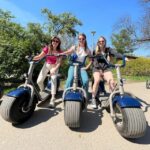
You also get the basics that turn a bike day into a smooth day: a bicycle and a helmet. When those are handled, you don’t waste time negotiating rentals or stressing about safety gear.
You can also read our reviews of more cycling tours in Berlin

Price and what feels like good value at $42.34
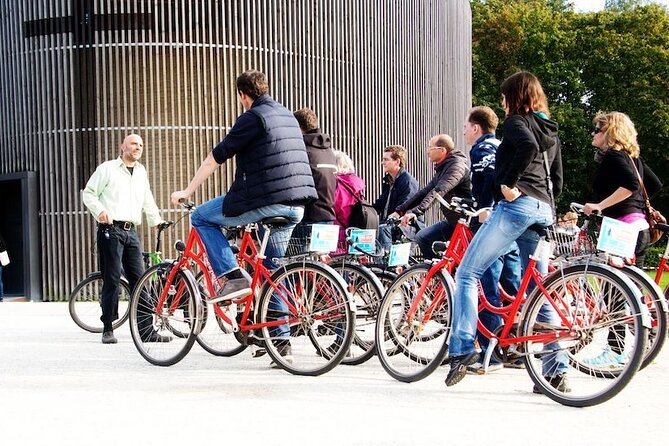
At $42.34 per person for roughly 3 hours, the value comes from what’s included and how efficient the route is. You’re paying for a guide, a bike, and a structured path that hits multiple top-of-mind sights in one sweep.
This is especially fair if you’re visiting only a short window and you want to avoid piecing together transit plus multiple ticketed attractions. Most of the stops here are free to enter, so your money goes toward interpretation and movement, not a pile of admissions.
The tour is also generally easy to join. It’s built to work in typical traffic conditions, and it runs in all weather, so you’re not trapped waiting for perfect skies.
Nikolaiviertel and the TV Tower: starting with Berlin’s staged old-town vibe
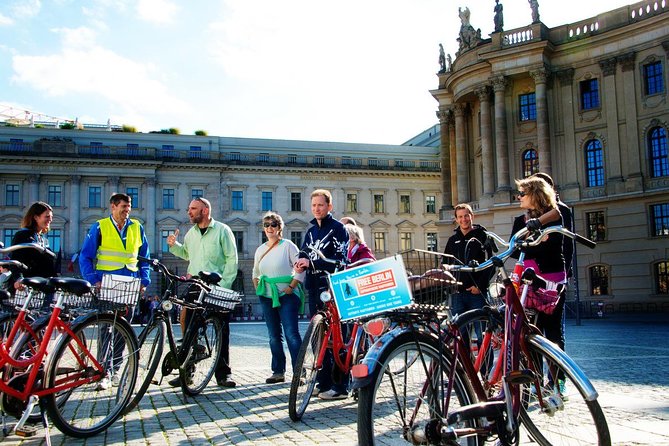
You begin at Nikolaiviertel, an older-feeling neighborhood that leans into Berlin’s idea of an old town. It gives you an early sense of texture and scale before the tour accelerates into major monuments and historical nodes. Even when places are carefully rebuilt or shaped for effect, they still help your eyes learn the city’s layout fast.
Then you head toward the famous TV Tower moment. The guide frames it as a major skyline icon, and the big detail here is that when it opened in 1969, it was the second tallest in the world. That single fact turns the tower from a postcard into a historical marker of what Berlin (and its leaders) were trying to project at the time.
What I like about starting with these two stops is the contrast. You move from a human-scale “old Berlin” atmosphere into a massive, unmistakable piece of modern symbolism, then you layer in the political meaning next.
Book Burning Memorial at Bebelplatz: a viewpoint for the city’s power story
Bebelplatz is one of those places where the “spot” matters as much as the content. At the Book Burning Memorial, you learn how Nazis used public spectacle by burning thousands of books. That’s heavy material, but it’s presented in a way that connects to what the space itself represents.
The stop also works as a mini overview of the surrounding institutions. From this area you get a “panorama” feel for the mix of old university presence, an old opera building, a catholic cathedral, a hotel that once served as a bank, and a guard’s house with temple-like styling. It’s a quick lesson in how Berlin stacks roles and eras on top of each other in the same city block.
There’s also a specific academic claim woven into the stop: the nearby university is described as home to more than 25 Nobel Prize winners, including Albert Einstein and other major thinkers linked with Karl Marx. That detail helps you understand why Bebelplatz feels like more than a monument. It’s a place where ideas, institutions, and political control collide.
Practical note: because this is a bike tour highlight, your time at each stop is brief. If you want deeper reading, take notes here so you know what to research later on your own.
Checkpoint Charlie (English option only) and Potsdamer Platz: the border line and the in-between world
Checkpoint Charlie is the big Cold War stop, and it’s important that it appears only on the English version. If you’re booking in English, this is one of the reasons the tour feels complete for the classic, globally recognized Berlin narrative.
Even in a quick stop, this place teaches you how the border system worked as theater. It’s not just history behind glass. It’s the feeling of a city sliced and managed, and your guide ties that into what you’re about to see next.
Then you move to Potsdamer Platz, where the tour changes tone from border drama to urban transformation. Potsdamer Platz is described as a mix of roaring traffic crossroads and a night vibe tied to the Roaring Twenties, followed by the idea of “no man’s land” during division. It’s also framed as Europe’s biggest construction site around the Millennium.
This stop is one of the best examples of why biking works here. Potsdamer Platz is hard to fully sense if you arrive late or from the wrong angle. On a bike, you’re constantly rotating through viewpoints, which makes the city’s reshape feel real instead of abstract.
You can also read our reviews of more guided tours in Berlin


Memorial to the Murdered Jews of Europe: silent, then back on the move
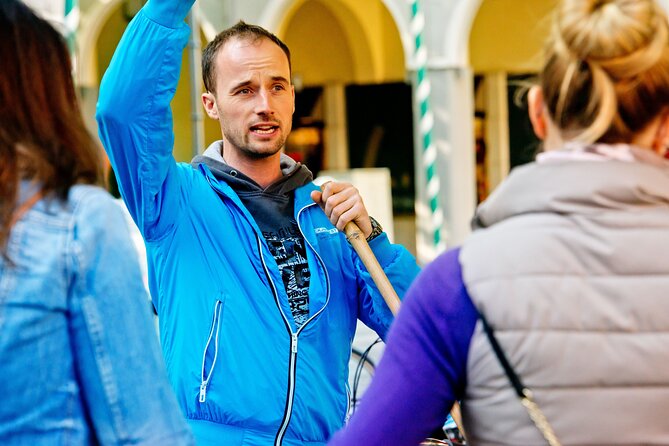
The Holocaust Memorial stop is presented as a direct confrontation with Nazi crimes and Germany’s struggle to keep memory present. It’s one of those locations where you don’t want a lot of chatter, and the guide’s role is less about entertainment and more about context.
Because this tour keeps things moving, your time here is limited. That can be good if you need a first encounter without being overwhelmed. It can be frustrating if you’re hoping for a long, personal visit. Either way, think of this as a “see it, understand the intent, then return if you need more.”
If the topic is emotionally heavy for you, it helps to pace yourself. Drink water before the ride if you can, and take slow breaths during the stop so you don’t rush yourself.
Tiergarten break: why a bike tour needs a park pause
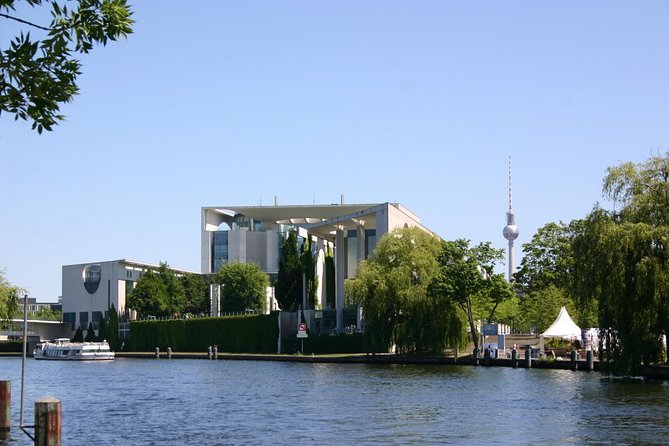
After the memorial stop, you head into a big green break: Berlin’s park area called Tiergarten, explained here as the Garden of the Animals—despite having no real zoo function anymore. It’s a clever piece of wordplay, but it also signals a practical rhythm shift. You’ve spent time in symbolic spaces; now you need air and movement.
This is where your legs often feel better too. Even if you’re not pedaling nonstop, the change in surroundings lets you reset mentally. It’s not a “random stop.” It helps the tour avoid becoming one long line of monuments in a row.
Brandenburg Gate and Reichstag: classic photos with modern meaning
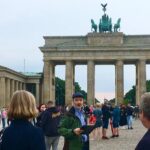
Then you reach Brandenburg Gate, Berlin’s icon, framed as a symbol for many reasons. It’s a place where you’ll understand why people keep photographing it. Even on a short stop, it’s hard not to feel the weight of what a gateway symbolizes across regimes.
After that comes the Reichstag building, Germany’s parliament, with its pride in a transparent dome. This is one of the best “now” moments on the route: democracy and visibility, not just memory.
There’s also a storytelling moment around the comparison people make to the US “White House.” The guide notes that many of those jokes aren’t true, and that line has a practical purpose. It nudges you toward looking at Berlin’s own political identity instead of using foreign references to explain away the details.
If you’re the kind of person who likes photos, you’ll get the classic shots. Just remember the tour format limits time. Use your brief windows to capture angles, then save the deep staring for when you return under your own schedule.
Museum Island: “Spree Athens” and the architecture quick-hit
The route ends at Museum Island, described here through its striking architecture and the nickname Spree Athens. Even with a short stop, this area communicates “culture as state identity.” It’s not only museums; it’s a visual plan of how Berlin wanted knowledge to look.
If you want to turn this highlight into a full day, Museum Island is an obvious place to add a second visit. The bike tour gives you the orientation. A later walking pass lets you slow down and choose which building matters most to you.
The one detail that can change your tour: Free-Berlin route design
One of the coolest things about this company’s approach is the Free-Berlin concept, where each guide designs their own route. That means you’re not guaranteed an identical sequence every time, even though the core big-hitters are the same idea.
So if you compare notes with someone who rode earlier, don’t be surprised if timing or emphasis feels slightly different. For you, the benefit is that you’re more likely to get the guide’s strongest, clearest connections between sites rather than a rigid checklist.
What to watch for before you book
This is a highlights tour with short stops. That’s great for coverage, but it can mean limited photo time. If you’re picky about taking pictures and you hate feeling rushed, you may want to do a separate slow walk afterward through the 1-2 places you care about most.
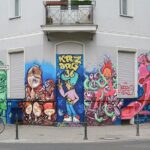
Also, this route leans into political memory. If your idea of Berlin is street art, modern design, and nightlife, you’ll still see some of that energy, but the narrative thread here is heavier. If you want the arts side, pair this with an art-focused outing on a different day.
Finally, English quality can vary by guide style. The tour is offered in English, and guides can be friendly and funny, but if clear spoken English is essential for you, pick a time slot that works with your comfort level and come prepared with questions.
Should you book this Berlin bike highlights tour?
Yes, if you want an efficient, guided overview that helps you understand Berlin’s big symbols in one half-day. The mix of Brandenburg Gate, Reichstag, Checkpoint Charlie (English option), the Holocaust Memorial, and Museum Island is a strong first-pass circuit, and the included bike and helmet reduce friction.
Skip it or add a plan if you need long stops, heavy museum time, or lots of arts-first wandering. This tour is built to move. Think of it as your map, your context, and your motivation to return for the places that tug at you most.
FAQ
How long is the Berlin guided bike tour?
It runs for about 3 hours.
What does the tour cost?
The price is $42.34 per person.
What is included with the bike tour?
You get a bicycle, a helmet, and a professional guide.
Which languages are available?
The tour operates in English, German, and French, depending on the chosen option.
Is Checkpoint Charlie part of every version?
Checkpoint Charlie is included only in the English version.
Are food and drinks included?
No. Food and drinks are not included unless specified.
Is this tour family-friendly?
Children are welcome, and infant seats can be provided on request. Children must be accompanied by an adult.
Does the tour run in bad weather?
Yes. It operates in all weather conditions, so dress appropriately.
FAQ
How many people are in a group?
The group size is between 4 and 15, with a maximum of 15 travelers.
Is free cancellation available?
Yes. You can cancel for a full refund up to 24 hours in advance.
Can I get a refund if I cancel late?
If you cancel less than 24 hours before the experience starts, the amount you paid will not be refunded.
Where do I meet the tour?
The meeting point is Free Berlin Bike Tours & Rental, Poststraße 11, 10178 Berlin, Germany.
Is there a ticket you need to show on your phone?
Yes. The tour uses a mobile ticket.
Do I have to pay for the stops?
The tour description indicates the stops listed are free, and there are free admission tickets listed for each stop.
What should I do at the end of the tour?
The activity ends back at the meeting point.
Do I need to confirm my booking right away?
You’ll receive confirmation at the time of booking.