REVIEW · BERLIN
Where It All Began: Berlin’s Queer & Trans History Tour
Book on Viator →Operated by BerlinGuide.de · Bookable on Viator
History gets personal in Berlin.
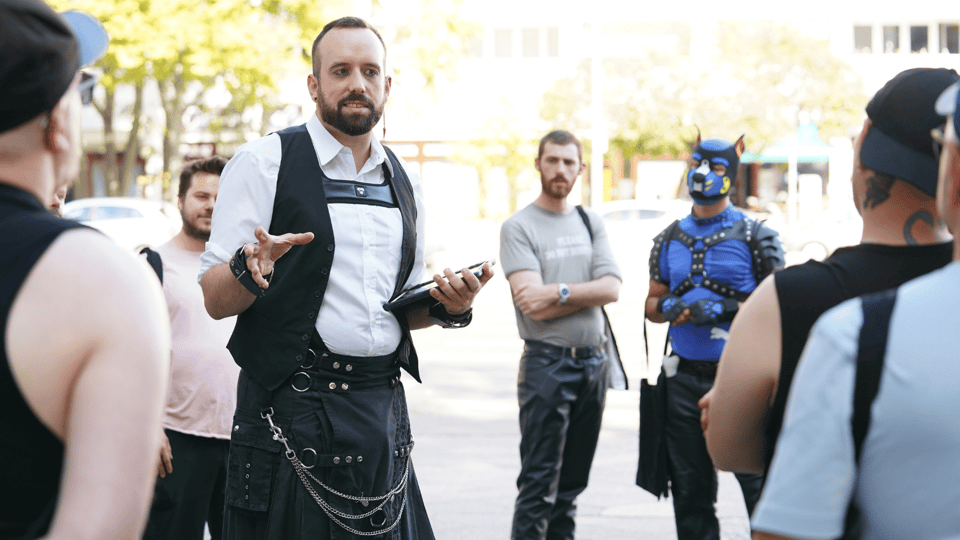
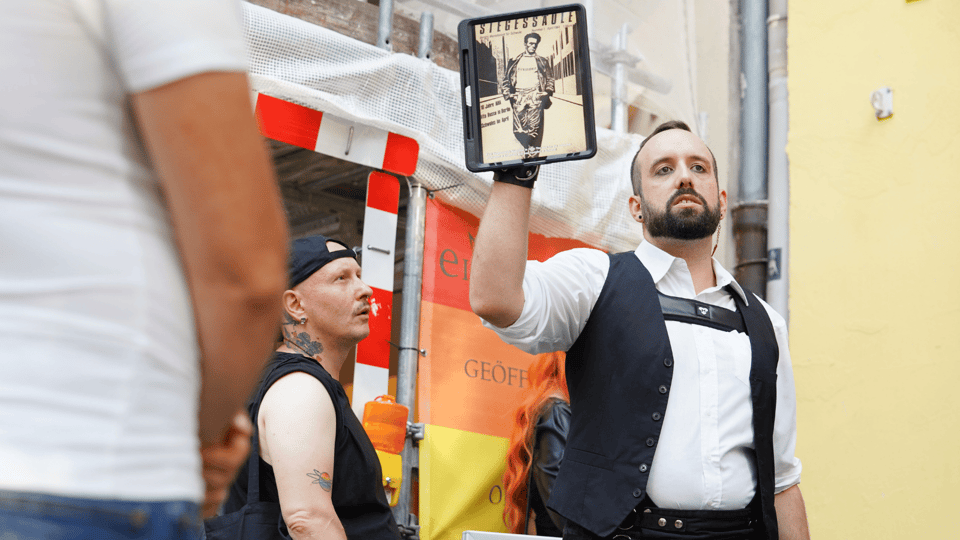
This 3.5-hour queer and trans history tour traces key turning points in LGBTQIA+ life, rights, and backlash through the streets of West Berlin and beyond, led by Jeff, a queer activist and gender scholar who can make hard moments feel clear instead of overwhelming. I love the small-group size (max 10), which keeps questions flowing, and I love the iPad augmented reality elements that layer historical photos onto the exact spots you’re standing in.
One possible drawback: the route is weather-dependent, so if Berlin turns rainy, you’ll want a backup plan.
In This Review
- Quick highlights
- Start to Finish: What This 3.5-Hour Walk Really Feels Like
- Price and Value: Why $83.13 Can Make Sense Here
- Where You Meet and Where You End (Plus the Timing That Helps)
- Stop 1: Karl-Heinrich-Ulrichs-Straße 1 and the First Public Gay-Rights Voice
- Stop 2: Nollendorfplatz and How Nazi Germany Crushed LGBTQIA+ Life
- Stop 3: Schwerinstraße 13 and Lesbian Life Through Music, Bars, and Resistance
- Stop 4: Nollendorfstraße 17 and Queer Inspiration, Including Christopher Isherwood
- Stop 5: Magnus-Apotheke and Hirschfeld’s Institute for Sexual Science
- Stop 6: Drag at Eldorado’s Former Site (and the Contradictions of Ernst Röhm)
- Stop 7: Prinz Eisenherz and the Aftermath in Post-War Berlin
- Stop 8: Connection at Chez Romy Haag and Trans-Led Club Culture
- Stop 9: Internationale Stele GEGEN DAS VERGESSEN and the AIDS Crisis
- Stop 10: Metropol and Today’s Queer Nightlife, Pride, and Gentrification Battles
- The iPad AR and Mixies Photos: Why This Tour Feels Different Than Reading Plaques
- Who This Tour Best Suits (And Who Might Want Something Else)
- Should You Book This Berlin Queer & Trans History Tour?
- FAQ
- How long is the tour?
- What language is the tour offered in?
- What group size should I expect?
- Where do I meet the guide?
- Where does the tour end?
- What’s included in the tour price?
- Is food included?
- Are there admission fees at the stops?
- Are service animals allowed?
- What about weather and cancellations?
Quick highlights
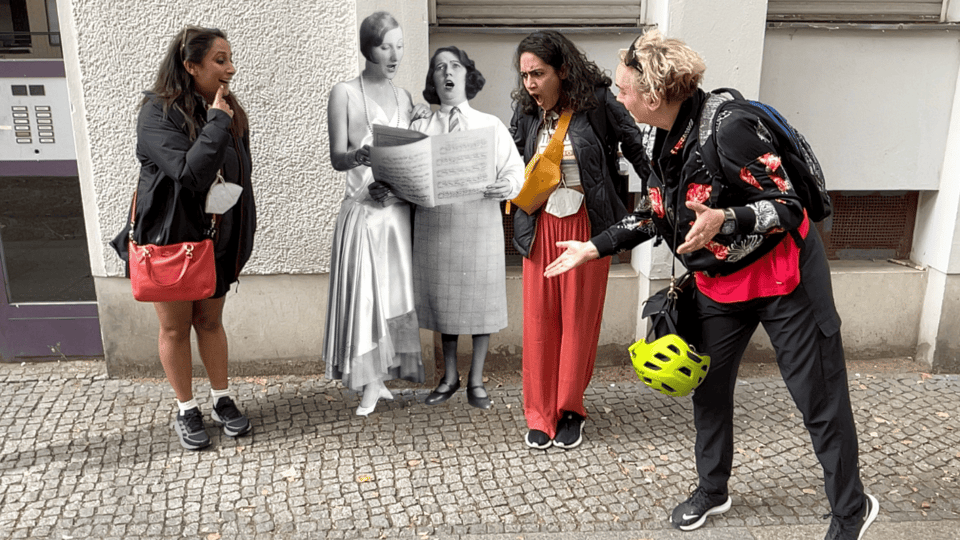
- AR history overlays on an iPad at real street locations, plus group photos via Mixies
- Stop-by-stop stories covering Nazi persecution, lesbian nightlife, and post-war organizing
- Names you’ll actually remember like Magnus Hirschfeld, Dora Richter, Lili Elbe, and Charlotte von Mahlsdorf
- Built-in modern context at the end, connecting today’s queer nightlife, Pride, and anti-gentrification work
- Walking tour format with a tight group, so you’re not just reading plaques and moving on
Start to Finish: What This 3.5-Hour Walk Really Feels Like
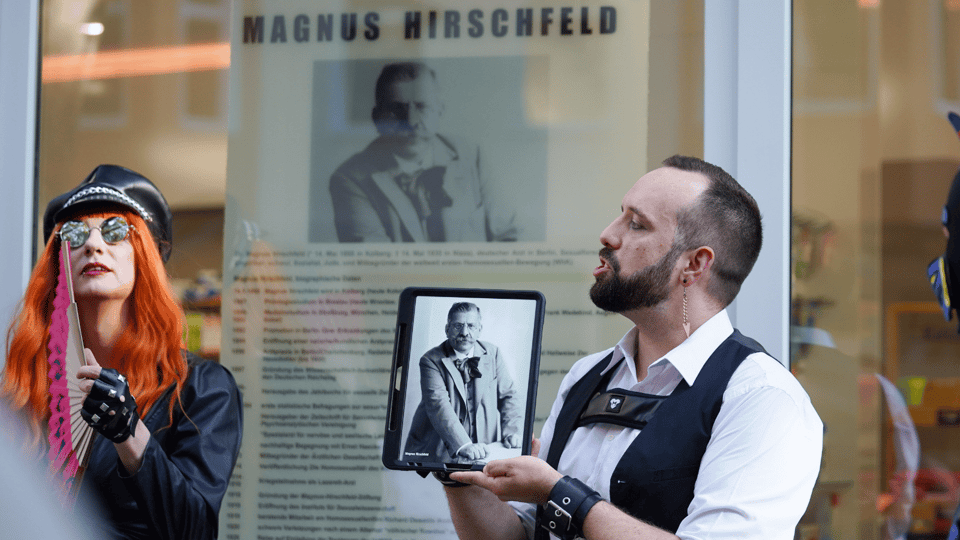
This tour moves in a way that’s easy to follow: you start in Schöneberg and work toward Metropol, ending in the middle of Berlin’s queer nightlife ecosystem. With a total time of about 3 hours 30 minutes, it hits enough ground to feel like a full morning or afternoon activity, but it never tries to cover everything in Europe in one go.
The biggest difference from a standard sightseeing walk is the emotional timing. You’re not only learning dates. You’re seeing how ideas about gender and sexuality changed over time, and how communities responded when the rules got harsher. That’s why the guide’s balance matters so much. Jeff has a way of keeping the stories human—sometimes funny, often moving—without turning them into shock value.
You can also read our reviews of more historical tours in Berlin

Price and Value: Why $83.13 Can Make Sense Here
At $83.13 per person, this isn’t the cheapest thing you’ll do in Berlin. But you’re paying for three concrete advantages that are harder to replicate on your own:
First, you get structured context at 10 meaningful stops, so you don’t have to guess what you’re looking at. Second, you get a guided experience led by someone who understands queer and trans history as lived experience, not just academic bullet points.
Third—and this is the practical “wow” factor—you’re provided an iPad for augmented reality, plus Mixies photos. If you enjoy having something to take home that’s more than a selfie stick memory, that AR layer can make the past feel anchored to the present in a way guidebooks rarely do.
Where You Meet and Where You End (Plus the Timing That Helps)
You start at Alnatura Super Natur Markt, Else-Lasker-Schüler-Straße 18, 10783 Berlin, and the tour begins at 2:00 pm. You finish at Metropol, Nollendorfpl. 5, 10777 Berlin.
That end point is more than convenient. It means you’re not exiting the story at some random corner. You end in a club-world location, which helps you connect the activism and community-building you just learned about with the scene that continues today.
Stop 1: Karl-Heinrich-Ulrichs-Straße 1 and the First Public Gay-Rights Voice
The tour begins at Karl-Heinrich-Ulrichs-Straße 1, named for Karl Heinrich Ulrichs, often described as one of the earliest people to publicly advocate for decriminalizing homosexuality. What I like about starting here is that it frames queer identity as something people discussed and theorized early on, not just something that later got forced into stereotypes.
This stop is also a reminder that activism didn’t appear out of nowhere. Even before modern terms existed, people were arguing for recognition and legal change. That makes the rest of the tour hit harder, because you’re watching rights talk meet political repression.
Stop 2: Nollendorfplatz and How Nazi Germany Crushed LGBTQIA+ Life
At Nollendorfplatz, the story shifts sharply into persecution under Nazi rule. You’ll hear about Adolf Brand and right-wing gay activists, and the complicated, painful reality of how Ernst Röhm related to the Nazi party while many queer people were still part of the system.
The tour also points directly at consequences: Hitler’s stance contributed to mass persecution, including what happened during the Night of the Long Knives, when Röhm and other queer individuals within the Nazi party were executed. You’ll also learn about concentration-camp persecution, where people were forced to wear the pink triangle, and how resistance and resilience still mattered even under extreme violence.
This stop is heavy, but it’s not vague. It gives you names, specific events, and a sense of how quickly a society can flip from ideology to brutality.


Stop 3: Schwerinstraße 13 and Lesbian Life Through Music, Bars, and Resistance
Next you move to Schwerinstraße 13, where the focus is lesbian life in 1920s Berlin—often overlooked compared to gay male narratives. The tour brings you to the site associated with Toppkeller, a well-known lesbian bar, and uses that space to explain why venues like this weren’t just entertainment. They were safety, community, and visibility.
You also pick up cultural context through figures like Claire Waldoff, whose cabaret songs became anthems of defiance. And you get a wider angle with Josephine Baker, highlighted here as a bisexual performer whose fame shaped how many people thought about gender and performance.
One practical thing: this stop is a good emotional breather after the Nazi material, but it still keeps the tone grounded. It’s not a nostalgia tour.
Stop 4: Nollendorfstraße 17 and Queer Inspiration, Including Christopher Isherwood
At Nollendorfstraße 17, the tour explores something surprising: the homosexual department of the Berlin police force. That detail matters, because it shows that queer life wasn’t simply invisible. It was policed, categorized, watched.
You’ll then hear about gay male life in 1920s Berlin and the story of Christopher Isherwood, whose writings about Berlin helped inspire the famous Cabaret musical and film. The tour also touches on his relationship with Heinz Neddermeyer and their escape from Nazi Germany as queer refugees.
If you’ve seen Cabaret and thought the setting felt theatrical, this stop helps you understand the real-world pressures behind the art.
Stop 5: Magnus-Apotheke and Hirschfeld’s Institute for Sexual Science
One of the most important stops is at Magnus-Apotheke, tied to Magnus Hirschfeld and his Institute for Sexual Science. This is where the tour leans into the idea of Berlin as a place where queer and gender theories were developed and discussed publicly—along with gender studies and medical experimentation.
You’ll hear about the Scientific-Humanitarian Committee, described as the world’s first organization dedicated to queer rights and gender studies. The tour also covers ideas like “sexual intermediaries” and the concept of a Berlin “third gender,” plus the grimly fascinating reality of world-first gender-affirming surgeries connected to people like Dora Richter, Lili Elbe, and Karl M. Baer.
Then Jeff connects it to the political fight: the battle against Paragraph 175, the law that criminalized homosexuality. Finally, you learn what the Nazis did to the Institute—how it was destroyed, which the tour treats as a major loss for queer history.
This stop is often where the tour’s AR features can feel especially powerful. When you’re seeing how an intellectual movement was tied to a specific address, the past feels less abstract.
Stop 6: Drag at Eldorado’s Former Site (and the Contradictions of Ernst Röhm)
At Denns BioMarkt, you’ll hear about Eldorado, one of Berlin’s famous drag bars in the 1920s. The tour treats this stop like a case study in community: gender-nonconforming people and queer performers found a place to exist out loud.
But it also includes the contradictions people still struggle with. The tour explains that even high-profile Nazis like Ernst Röhm reportedly frequented the club, even as the regime later persecuted LGBTQIA+ people.
That contrast can feel uncomfortable, and that’s the point. It forces you to look at how systems can exploit spaces while later turning on the very people they tolerated, controlled, or categorized.
Stop 7: Prinz Eisenherz and the Aftermath in Post-War Berlin
At Prinz Eisenherz, the focus moves forward to post-WWII activism. You’ll learn about Homosexuelle Aktion West-Berlin, described as one of the first queer rights organizations after the war, and you’ll hear about the founding of SchwuZ, one of Berlin’s iconic queer clubs.
This stop also spotlights Charlotte von Mahlsdorf, a trans woman who helped preserve Berlin’s queer history and created safe spaces for the community in East Berlin. I like how the tour doesn’t treat East and West Berlin as interchangeable. It makes the division feel real through the way activism and nightlife took different shapes.
Stop 8: Connection at Chez Romy Haag and Trans-Led Club Culture
At Connection, the tour turns to the trans community in West Berlin during the 1970s and 1980s, with emphasis on Chez Romy Haag. The story here is that the club helped revolutionize Berlin’s nightlife by creating a space where gender-diverse people could exist more freely.
This stop is especially useful if your Berlin experience is mostly about today’s scenes. It gives you roots—how the clubs you hear about now were influenced by spaces where trans people had real room to lead.
Stop 9: Internationale Stele GEGEN DAS VERGESSEN and the AIDS Crisis
Next you reach a stop focused on the AIDS crisis and how it affected a divided city. The tour explains how queer communities organized to survive, and it names Rita Süssmuth as one of the few politicians pushing for AIDS awareness.
One line that helps you picture the scale of the difference between East and West: Berlin Wall comparisons described it metaphorically as the condom of the GDR. Whether you take that literally or just as a sharp metaphor, it helps you remember that responses to AIDS weren’t uniform.
This is where the tour’s emotional range becomes clear. It’s not only about legal fights and nightlife. It’s about life and urgency and public health—and what people did when help lagged behind need.
Stop 10: Metropol and Today’s Queer Nightlife, Pride, and Gentrification Battles
The final stop is at Metropol, and it brings the story straight into the present. You learn about Metropol’s role in early gay community and the techno scene, plus its connections to places associated with today like Berghain and Lab.Oratory.
The tour also covers major queer events and nightlife traditions: SO36 and legendary queer nights, Folsom Europe (called Europe’s biggest fetish festival), Kreuzberg Pride, and the Dyke March. It doesn’t stop at celebration, either. You also hear about the ongoing fight for an affordable city through the Tuntenhaus squat.
This ending works because it changes the feeling from history lesson to living context. You leave with a sense that queer and trans activism in Berlin isn’t a chapter in the past. It’s an ongoing negotiation.
The iPad AR and Mixies Photos: Why This Tour Feels Different Than Reading Plaques
A standard walking tour gives you narration. This one adds a layer you can actually use: an iPad AR experience with historical photos, videos, and archival materials—200+ items in total. At key spots, the historical images get shown in place, and you can take fun personalized photos through Mixies.
In practice, it helps three things:
- You remember locations better because the past overlays where you are.
- You notice details you’d otherwise walk past.
- You end with something concrete to share, not just notes you took.
That’s exactly the kind of “how did they make this work so well?” feature that earns a 5-star reputation.
Who This Tour Best Suits (And Who Might Want Something Else)
This experience is built for most travelers and it’s designed for small groups. If you want a Berlin queer and trans history tour that connects activism, culture, and nightlife, you’ll likely enjoy it.
It also helps if you like guided storytelling more than self-guided research. The stops are name-rich and concept-rich—ULRICHs, Hirschfeld, Röhm, Isherwood, Romy Haag, and more. If you try to do this alone without a guide, you might get the sites, but you could miss why each place matters.
If you only want light, upbeat sightseeing, this may feel too serious in places. The Nazi-era and AIDS-crisis stops are not toned down.
Should You Book This Berlin Queer & Trans History Tour?
Book it if you want a guided walk that covers real turning points—from early activism and gender theory to persecution, resistance, and the club culture that kept communities connected. The combination of Jeff’s story-driven approach and the iPad AR photos is the kind of value you feel, not just something listed on a website.
Think twice if you hate walking tours or you’re traveling in weather that Berlin is likely to throw at you. This one requires good weather, and the route is designed as a continuous walk.
If you’re looking for one strong, coherent way to understand Berlin’s LGBTQIA+ and trans history in a single afternoon, this is a very smart pick.
FAQ
How long is the tour?
The tour runs for about 3 hours 30 minutes.
What language is the tour offered in?
It’s offered in English.
What group size should I expect?
The tour has a maximum of 10 travelers.
Where do I meet the guide?
You’ll meet at Alnatura Super Natur Markt, Else-Lasker-Schüler-Straße 18, 10783 Berlin.
Where does the tour end?
It ends at Metropol, Nollendorfpl. 5, 10777 Berlin.
What’s included in the tour price?
Included items are the guided walking tour led by a queer activist and gender scholar, augmented reality elements on an iPad, Mixies personalized AR photos, 200+ rare historical photos/videos/archival materials, and insider tips on modern queer nightlife and events.
Is food included?
No. Coffee and/or tea and a drink at a café are not included.
Are there admission fees at the stops?
The tour information lists admission tickets for these stops as free.
Are service animals allowed?
Yes, service animals are allowed.
What about weather and cancellations?
The experience requires good weather. If it’s canceled due to poor weather, you’ll be offered a different date or a full refund. You can cancel for free up to 24 hours in advance for a full refund.