REVIEW · BERLIN
PRIVATE BEHIND THE BERLIN WALL and COLD WAR BERLIN TOUR
Book on Viator →Operated by Birchys Berlin Tours · Bookable on Viator
Berlin’s Cold War story walks beside you. You get a tight tour of the places where the wall mattered most, from the city’s dead-silent no-man’s-land days to the memorial you can still read like a scar. It’s all guided in English by a licensed pro, focused on Berlin Wall and Cold War realities.
I like that this tour hits the headline sites in one walking route, without a bus ride. I also like the human angle: strong guides turn dates into stories, including escape attempts and what happened to families on both sides of the divide.
One possible drawback: you’re on your feet for about four hours, and food isn’t included. If you’re visiting in winter or bad weather, wear layers and be ready to warm up with a café stop on your own time.
In This Review
- Key points worth knowing
- Why this Cold War route works in one day
- Potsdamer Platz: From dead land to a reunified showpiece
- Topography of Terror and the surviving wall fragment on Niederkirchnerstrasse
- Checkpoint Charlie: the famous crossing and the 1961 face-off
- GDR watch tower: seeing surveillance from the inside edge
- Memorial of the Berlin Wall: the 1km segment you’ll remember
- How the guides shape your day (and why that matters)
- Price and value: what you really pay for at $173.75
- Best-fit travelers (and who should plan differently)
- Should you book this Berlin Wall and Cold War tour?
- FAQ
- FAQ
- What’s the duration of the Private Behind the Berlin Wall and Cold War Berlin Tour?
- Is the tour private?
- Are food and drinks included?
- Do I need to buy tickets for the stops?
- What language is the tour offered in?
- Is pickup available?
- Do you use private transportation or vehicles?
- Can I cancel for a full refund?
- Are pets allowed?
Key points worth knowing
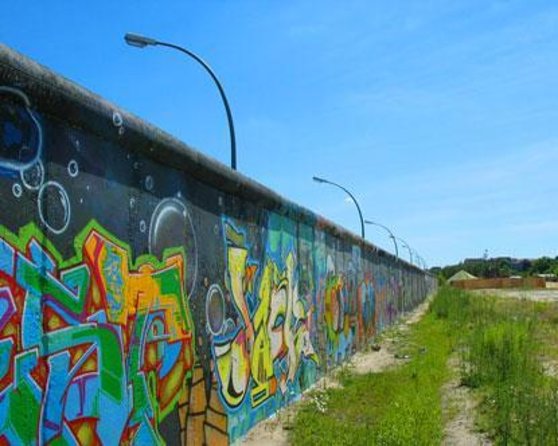
- Wall leftovers, not just plaques: you see surviving sections and rare structures tied to the system.
- Escape stories built into the route: the guide connects each stop to attempts to flee East Berlin.
- Free entry at the main stops: you pay mostly for the guide and the interpretation.
- Private group experience: only your group participates, so questions actually get answered.
- Morning or afternoon start times: easier scheduling around your Berlin plan.
- Pickup may be available: handy if you don’t want to hunt down the meeting point.
Why this Cold War route works in one day
This tour is designed for one goal: help you understand how Berlin became a living border. Instead of jumping randomly between monuments, you walk the key Cold War locations in a logical order that shows change over time—from separation to reunification.
You also get the main thing most self-guided plans miss: a guide who can explain what you’re looking at in plain language. At places like Checkpoint Charlie or the Berlin Wall memorial, it’s easy to treat everything like a photo spot. With a good guide, those same stops start feeling like evidence. The wall isn’t just a wall. It was policy, fear, and daily life.
And since the tour is private, you’re not stuck waiting for a group to move. In reviews, guides like Cairan and Paul were praised for answering questions, pacing the day, and keeping the story moving so you don’t lose the thread when you’re tired.
You can also read our reviews of more private tours in Berlin

Potsdamer Platz: From dead land to a reunified showpiece
Your first big stop is Potsdamer Platz, once described as desolate land in a city split by a hard border. Here, the lesson is scale and contradiction. Berlin’s Cold War division created empty spaces. After reunification, those same zones became high-rise business and entertainment territory.
Even in a short stop, it helps to see Potsdamer Platz early in the tour. It gives you a baseline: before you picture the wall, you understand how Berlin rebuilt itself around what the division left behind. This is one of those places where the city’s current energy can trick you into forgetting the recent trauma—until the guide reframes what you’re standing on.
Practical note: the stop is about 15 minutes. If you like photos, take them quickly and then use your guide’s explanation. This is not a “wander for an hour” kind of moment.
Topography of Terror and the surviving wall fragment on Niederkirchnerstrasse
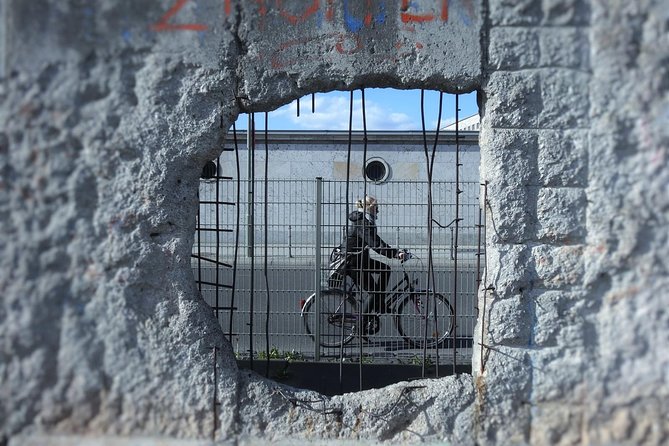
Next comes Topography of Terror, right near Niederkirchnerstrasse. This stop feels more grounded because you’re not just looking at interpretation boards. You’re seeing a surviving fragment of the wall in this part of Berlin.
What makes it hit harder is the location. It sits beside the former-Luftwaffe Headquarters, which was used during the East German period as the House of Ministries. That pairing matters: you’re standing where power and control overlapped with surveillance and repression.
And then the guide adds the human layer. This area is also tied to an escape story in a way that’s hard to shake—one of the more incredible escapes into West Berlin connected to this specific setting. When the guide ties the geography to the attempt, the place stops being abstract.
Time is about 15 minutes, so you’ll want to listen closely and decide what questions you want answered before you move on. If you’re someone who loves asking “how did they do it,” this is a strong spot to go into detail with your guide.
Checkpoint Charlie: the famous crossing and the 1961 face-off
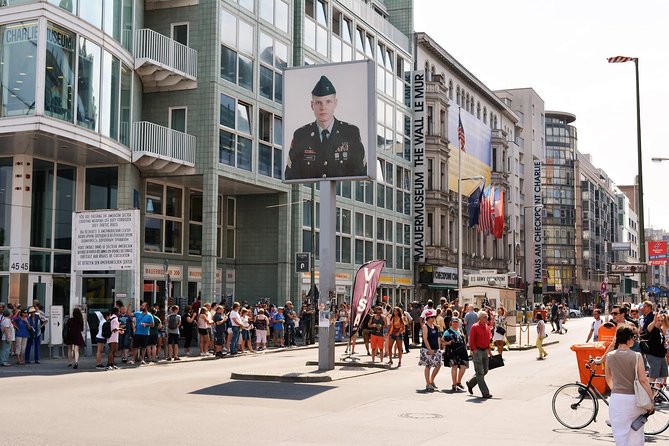
Checkpoint Charlie is the headline stop for a reason. It’s tied to many failed and successful escape attempts, plus a famous confrontation between American and Soviet forces in autumn 1961.
This is where you’ll see how Cold War tension played out in real time. The checkpoint wasn’t just a metaphor. It was a choke point where decisions got enforced with pressure, rules, and consequences. The guide’s job here is to connect those larger Cold War narratives to the individual stories—people trying to leave, and the very specific friction of crossing.
At about 20 minutes, you won’t get a long museum-style visit. But you will get context that turns a well-known name into something more precise. With the right guide, you’ll walk away understanding why Checkpoint Charlie became such a symbol—and why it also could be a trap.
GDR watch tower: seeing surveillance from the inside edge
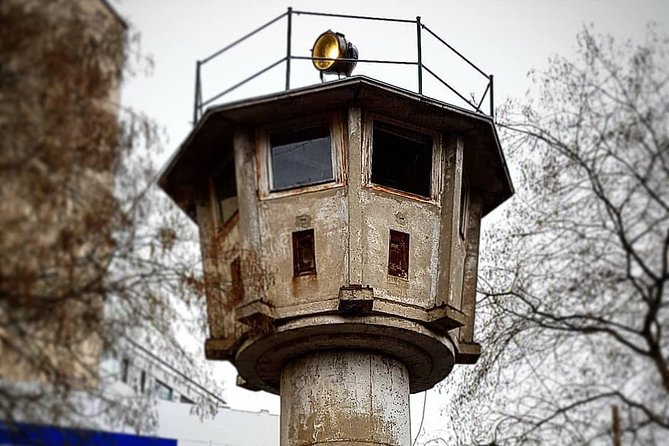
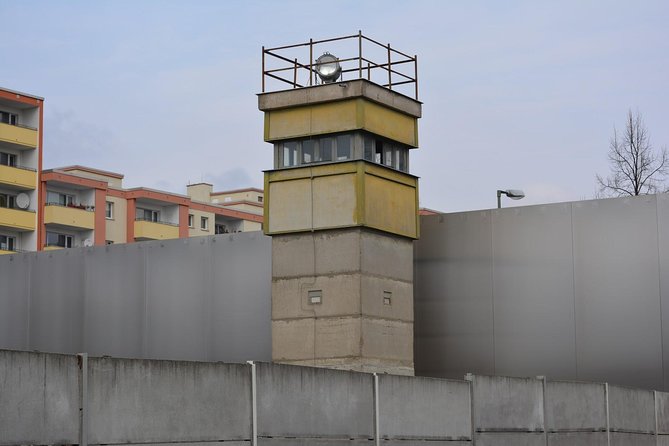
Next is the GDR Watch Tower—about a 10-minute stop, but with a big idea behind it. This is said to be the last of the BT variant watchtowers that used to surround West Berlin, and it survives because of a private initiative.
Even if you don’t climb, just knowing what you’re looking at changes how you interpret the rest of the border story. Watchtowers were part of the system that turned the border into a controlled zone. If you can ascend, it adds a practical viewpoint: you get a sense of lines of sight and why “visibility” was a weapon.
Because this is short, the guide has a chance to give you the core explanation fast. It’s a good contrast to Checkpoint Charlie: instead of focusing on the drama of a crossing, you focus on the quiet machinery of surveillance.


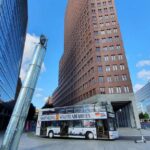
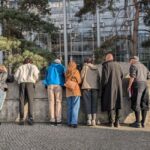

Memorial of the Berlin Wall: the 1km segment you’ll remember
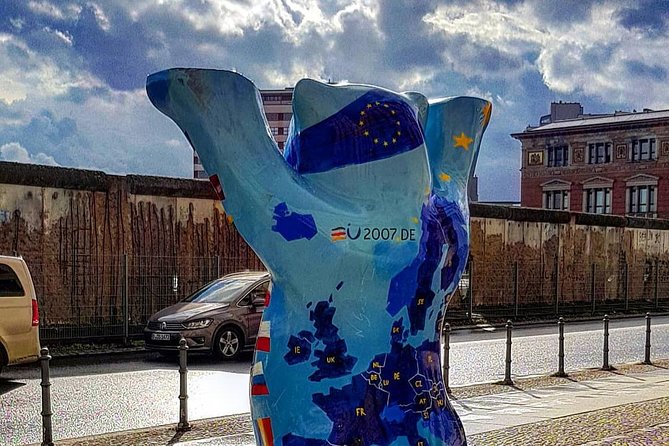
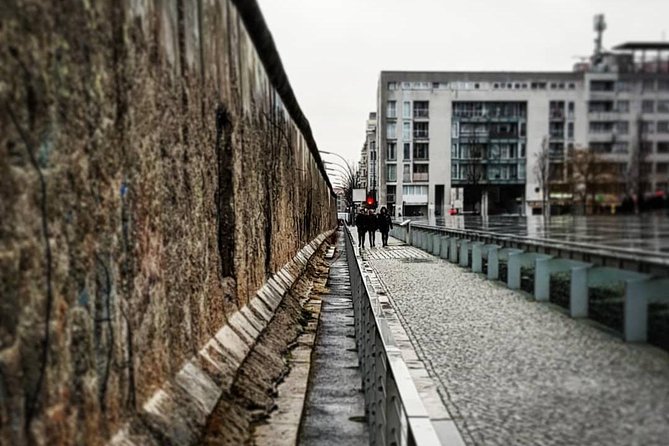
The emotional center of the tour is the Memorial of the Berlin Wall. It takes about 1 hour 20 minutes, and it’s the stop most likely to linger with you after the tour ends.
The memorial stretches over 1 kilometer and includes the only preserved complete cross-section of the Berlin Wall and the death-strip. That detail matters. A cross-section makes the wall’s logic easier to grasp: you’re not guessing what was where. You’re looking at a built structure designed to restrict movement.
This is also where the guide can make the story feel personal without turning it into melodrama. In reviews, guides such as Cairan and Paul were praised for telling stories of people trying to escape and families affected for decades. That kind of interpretation is exactly what helps here, because the memorial is also a record.
A key consideration: you’re still walking, and this is the longest stop. If you’re sensitive to long stands or cold weather, plan your layers and pace yourself. Listen for your guide’s cues on where to focus your attention.
How the guides shape your day (and why that matters)
This tour is priced for interpretation, not just transit between sites. That means the guide matters a lot, and the guide experience here shows up in the feedback.
I’ve seen guides like Cairan praised for timing the tour so you catch important places at moments that make the route easier. He also shared personal details such as pictures taken by his mother during the 70s–80s, which gives the Cold War story a family texture you don’t get from a standard script.
Paul and Reece were praised for strong narrative flow—explaining why the wall came to be, how the Cold War unfolded after World War II, and how events led directly into 1989. Darren brought a quirky sense of humor, which can keep heavy topics from becoming heavy in the wrong way. Kirin was described as able to handle the history and keep families engaged, even with teens in tow.
So here’s my practical takeaway: if you’re the kind of traveler who reads every sign, you’ll still be happy. But if you’re the kind who asks questions, this tour is built for that. The guide is your translator for what you’re seeing.
Price and value: what you really pay for at $173.75
At $173.75 per person for about four hours, this isn’t a bargain tour. But it’s not a money-sink either, because most of the main stops are free admission. In other words, your fee buys you something harder to find on your own: a licensed guide stitching together the wall’s geography, politics, and personal stories.
You also get a private format, which changes the value math. One-on-one or small-group attention usually costs more in Berlin, especially for English-guided history. If your group includes people who want to ask questions, the private setup can make the price feel more reasonable.
A small logistics note: since no vehicles are used, you’ll rely on walking and likely public transportation connections between sites if your guide decides the route benefits from it. One group noted extra public transport was required and that it wasn’t expected. So if you’re trying to keep steps low, ask your guide in advance what the day will look like pace-wise.
Best-fit travelers (and who should plan differently)
I think this tour is perfect if you’re a history fan, or if you know you want Cold War context but you don’t want to spend days researching before you arrive. It’s also great if you like tours that move you through real places instead of starting and ending with generic overviews.
It’s also a smart choice if you’ve got limited time. In one half-day you cover: Potsdamer Platz, Topography of Terror, Checkpoint Charlie, a surviving watch tower, and the big Berlin Wall memorial.
Where you might plan differently: if you hate walking, you’ll probably feel the time. Another consideration is weather. Even though guides keep going in rain and cold, your comfort is your responsibility—food and drinks aren’t included, so bring snacks or plan a café stop on your own terms.
Should you book this Berlin Wall and Cold War tour?
If you want one guided outing that connects the wall’s physical layout to the politics and the human stories, I’d book it. The stop choices are strong, and the memorial visit gives you the kind of detail you can’t easily recreate on your own.
I’d skip it only if you’re looking for a casual, low-effort stroll. This is active, and it asks you to pay attention. But if you can handle a few hours on foot, you’ll come away with a clearer sense of how Berlin worked as a real border—and why people risked everything to cross it.
FAQ
FAQ
What’s the duration of the Private Behind the Berlin Wall and Cold War Berlin Tour?
It’s listed as about 4 hours.
Is the tour private?
Yes. It’s private, and only your group participates.
Are food and drinks included?
No. Food and drinks are not included.
Do I need to buy tickets for the stops?
Admission is listed as free for the stops in the itinerary.
What language is the tour offered in?
The tour is offered in English.
Is pickup available?
Pickup is offered. The meeting point is Birchys Berlin Tours on Ebertstraße 24, 10117 Berlin, Germany, and the activity ends back at the meeting point.
Do you use private transportation or vehicles?
No. The tour notes that it does not use any vehicles.
Can I cancel for a full refund?
Yes. You can cancel up to 24 hours in advance for a full refund.
Are pets allowed?
Yes. Animals or pets are allowed.