REVIEW · BERLIN
Karl-Marx-Allee Walking Tour: Berlin’s Socialist History
Book on GetYourGuide →Operated by Beyond and Beneath Tours · Bookable on GetYourGuide
Karl-Marx-Allee looks like a monument to certainty. The more you walk it, the more it turns into a story about power, fear, and hope in East Berlin. I love how the tour connects the buildings to what people actually lived through, and I really liked having Martina as a guide—attentive and quick to keep the walk from feeling like a lecture.
Two things I’m most glad about: you get a clear look at how Cold War ideology shaped the architecture, and you hear the parts that don’t show up on a postcard—especially the surveillance mechanics tied to the Stasi. One thing to consider: this is an older-history style tour. If you want a casual stroll with zero heavy topics, you might find the Stasi content a bit intense.
In This Review
- Key things you will notice on this Karl-Marx-Allee walk
- Entering Berlin’s socialist boulevard, one block at a time
- Price and what you get for $23 in about 2 hours
- Route basics: starting at Frankfurter Tor, ending near Strausberger Platz
- Karl-Marx-Allee’s architecture: Cold War ideology in concrete
- The ambitious project behind the street’s grandeur
- 1953 uprising context: why the street nearly toppled the government
- Stasi surveillance: wiretaps and listening stations you would miss
- Hidden-and-hacked city view: trees, facades, and controlled appearances
- From East Germany to today: why the boulevard still matters
- Film locations you can spot: The Lives of Others and The Queen’s Gambit
- Who this tour suits best (and who should think twice)
- Practical tips so you enjoy it more
- Should you book the Karl-Marx-Allee socialist history tour?
- FAQ
- Where do I meet for the Karl-Marx-Allee walking tour?
- How long is the tour?
- How much does it cost?
- What languages are the tours offered in?
- Is the tour wheelchair accessible?
- What should I bring?
- Is the tour suitable for kids?
- What’s the general route like?
- Can I cancel for a refund?
- Who provides the tour?
Key things you will notice on this Karl-Marx-Allee walk
- Socialist classicism on a city scale: huge housing blocks meant to show what East Germany wanted people to believe
- A project that nearly broke the state: the 1953 uprising tied to the street’s construction era
- Stasi listening hidden in everyday space: wiretaps and listening stations, not just vague paranoia
- Poplars as visual editing: trees used to hide what the regime didn’t want seen
- East Berlin culture and the facade: shops and cafés that supported the illusion of ordinary prosperity
- Screen-world proof: filming locations linked to The Lives of Others and The Queen’s Gambit
Entering Berlin’s socialist boulevard, one block at a time
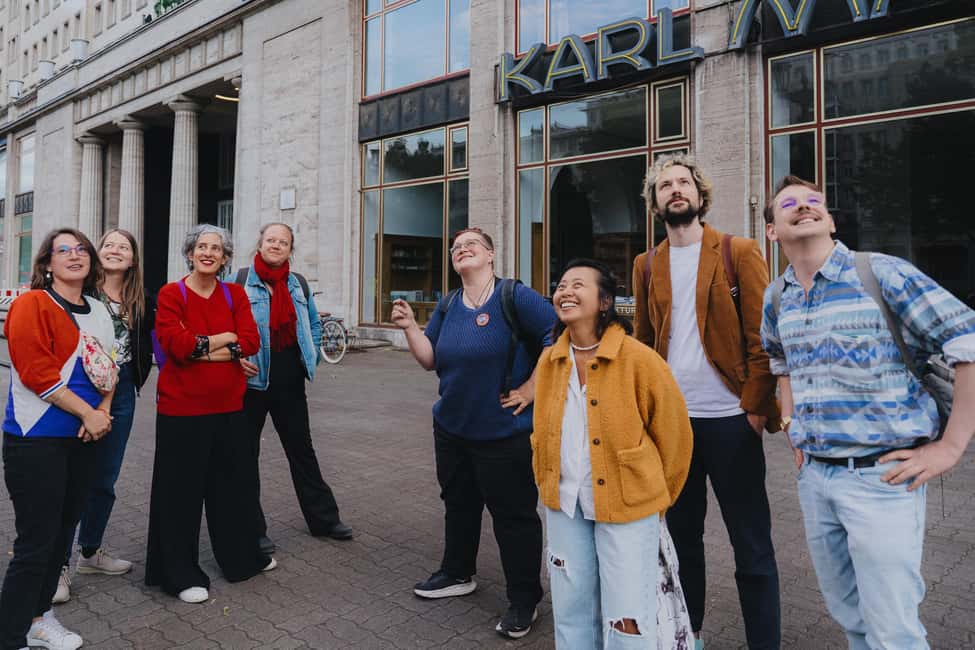
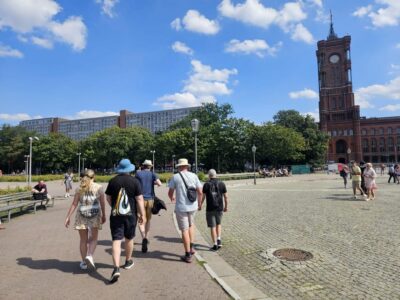
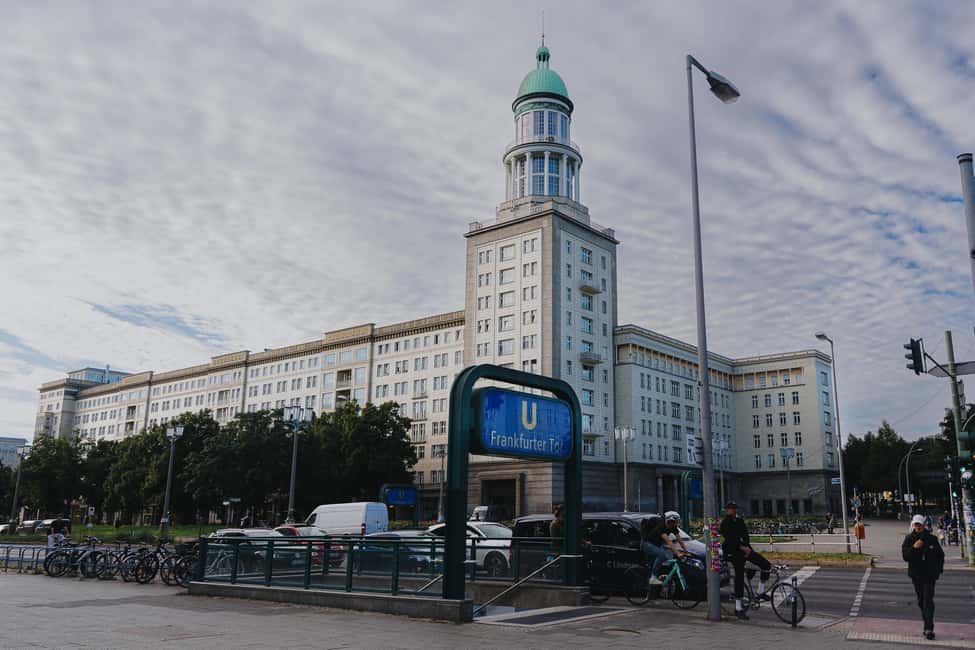
Berlin has a talent for turning streets into textbooks. Karl-Marx-Allee is one of the best examples. From the moment you start near U Frankfurter Tor, the street’s scale hits you. These aren’t small apartment blocks. They’re grand housing-fronts built to announce the existence and strength of a political project.
I like that the tour doesn’t treat the architecture as decoration. Instead, you learn to read it like a message. The “socialist classicism” style was chosen for a reason: it made the new East German world look stable, respectable, and permanent—even as the reality underneath was harder.
As you walk, the guide ties the street to multiple time layers. You get the post–World War II rebuilding phase, the later shift in what the regime preferred to show, and the long afterlife of these buildings after the Wall fell.
You can also read our reviews of more walking tours in Berlin



Price and what you get for $23 in about 2 hours
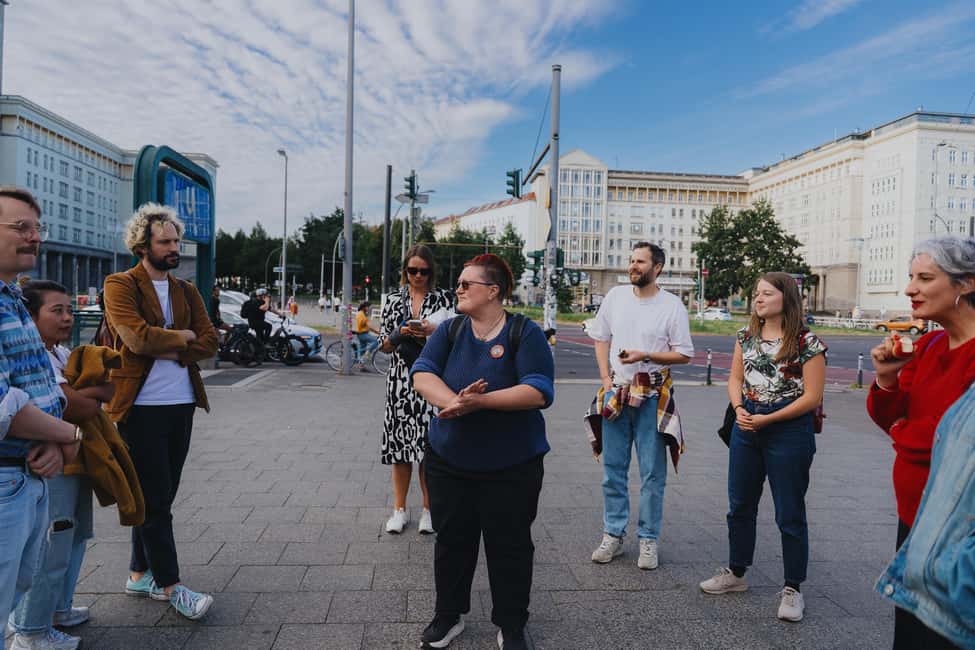
At $23 per person for a guided, English/German walking tour, the value is strong if you want context rather than a self-guided scavenger hunt. Two hours is also a smart length here. Karl-Marx-Allee is long enough to feel like a real outing, but short enough that you don’t need to plan your whole day around it.
This price includes a live guide, and that matters for this topic. Stasi surveillance and the 1953 uprising aren’t topics you’ll naturally “pick up” from the street’s stonework. A good guide helps you connect what you see with what it meant.
Route basics: starting at Frankfurter Tor, ending near Strausberger Platz
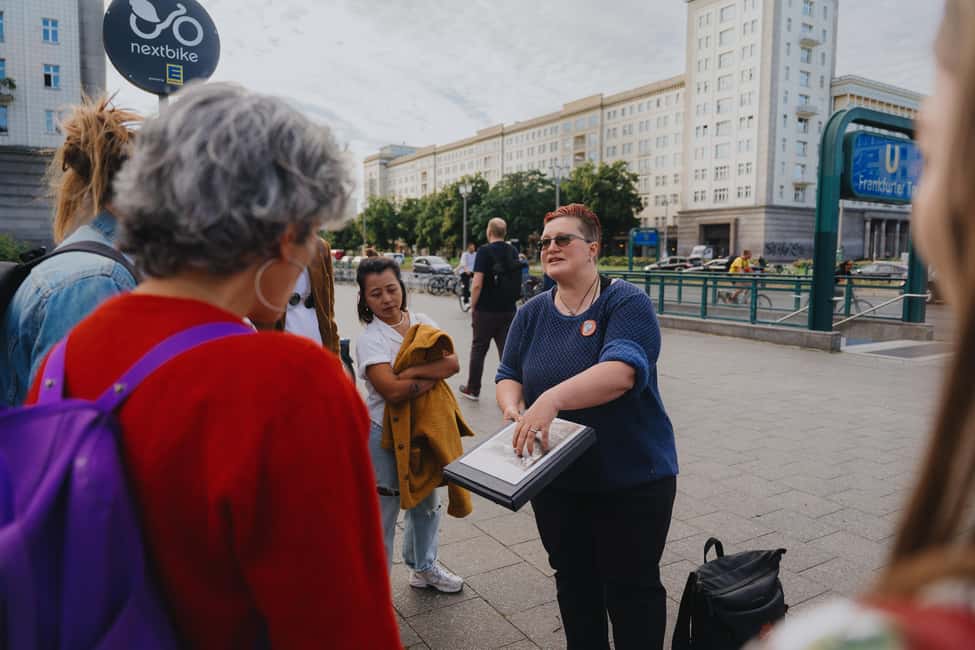
You meet outside U Frankfurter Tor, on the corner of Warschauer Straße and Karl-Marx-Allee, and you’ll be looking for your guide holding an orange umbrella. From there, the walk focuses on Karl-Marx-Allee itself, then wraps near U Strausberger Platz.
Practically speaking, this route is easy to plug into your Berlin day. You’re moving along a main corridor with straightforward transit access at both ends, so you don’t feel trapped once the tour is done.
Wear comfortable shoes. Even a “historical” walk becomes real walking once you’re following along the length of the boulevard.
Karl-Marx-Allee’s architecture: Cold War ideology in concrete

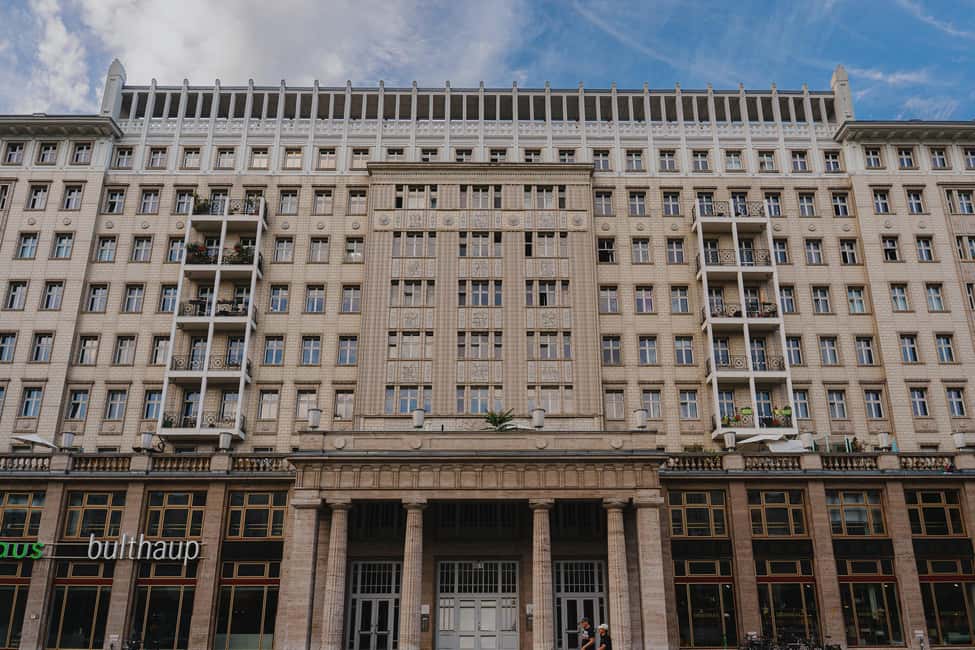
The buildings along Karl-Marx-Allee were designed as statements. The tour helps you notice how the street’s look reflects the Cold War competition over ideas. In East Berlin, architecture wasn’t just about shelter. It was a tool for shaping public belief.
You’ll spend time looking at the imposing housing blocks that reflect East Germany’s version of socialist “classic” style. The goal wasn’t subtle. You’re meant to feel small walking past it, because the street was built to project authority and order.
One of the most useful things the guide does is explain that this wasn’t the only idea on the table right after the war. The immediate post–World War II years brought modernist, utopian urban thinking—born in the ashes of destroyed Berlin. Later, the East German leadership pushed a different visual direction, and you can feel that shift in how the built environment presents itself.
The ambitious project behind the street’s grandeur
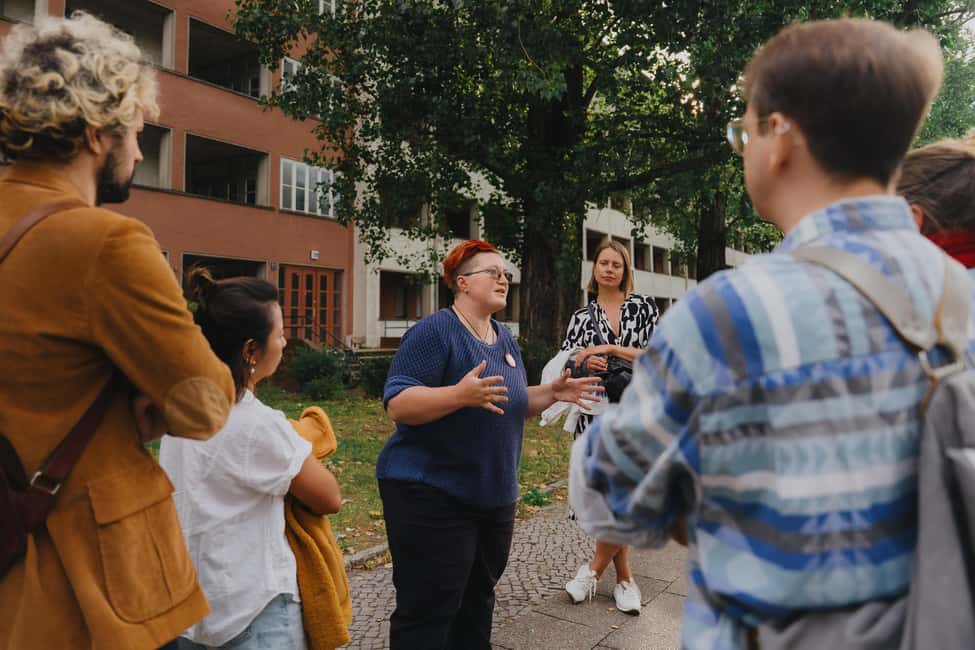
A key theme here is that Karl-Marx-Allee didn’t appear out of nowhere. It emerged from ruins with intense effort, including thousands of volunteers working day and night. That human effort is part of the story you should keep in mind as you walk, because it changes how you read the buildings.
The tour also makes clear the cost of building such a symbolic project. The street’s construction period was tied to instability, and in June 1953 disgruntled workers launched a mass uprising that nearly toppled the socialist government. That date matters. It turns the street from “historic background” into something tied to near-disaster.
If you like history with cause-and-effect, you’ll appreciate how the guide connects ideology, construction, and political pressure. The street is impressive, but it’s also fragile—politically and socially.
You can also read our reviews of more historical tours in Berlin





1953 uprising context: why the street nearly toppled the government

The 1953 uprising isn’t just a side note. It’s one of the reasons Karl-Marx-Allee deserves your attention. The tour frames it as a moment where dissatisfaction cut through the state’s messaging.
You’ll hear how workers’ anger escalated into a mass action that threatened the regime. In other words: the street’s monumental look wasn’t proof that everyone was satisfied. It was proof that the government needed a visible symbol of strength.
This is where the walk can feel more serious. The street becomes a setting for conflict, not just a background for neat photos. If you’re the kind of person who likes to understand how systems crack, you’ll get a lot out of this portion.
Stasi surveillance: wiretaps and listening stations you would miss
The most unsettling part of the tour is also the most “this could happen anywhere” part. The guide explains the truth behind the surveillance state and how Stasi methods were built into daily life.
You learn about wiretaps in flats and listening stations in attics. That detail is important because it reframes the topic from abstract fear to physical setups in residential spaces. You start looking at rooftops and internal layouts with new suspicion—because the point of the system was not only to watch, but to hide.
The tour doesn’t pretend surveillance was obvious. It emphasizes that it was meant to remain hidden, even while the street projected a polished image of normal life. That contrast—public comfort versus private control—is one of the most memorable lessons from this walk.
Hidden-and-hacked city view: trees, facades, and controlled appearances

Berlin loves visual tricks, and Karl-Marx-Allee includes an example straight from the regime’s playbook. The guide points out that the modernist architecture and elements of earlier ideals were intentionally hidden from passersby using fast-growing poplar trees.
That’s a clever detail, because it shows how control didn’t stop at laws or policing. It reached into what you could visually access. If the population wasn’t supposed to focus on certain ideas or styles, then the cityscape could be edited in real time.
You also learn how the street presented an image of idyllic life and affluence—cafés, restaurants, and well-stocked shops. The “best East Berlin” idea wasn’t accidental. It supported the facade, making socialism look comfortable and complete.
And then the tour snaps the balance back by explaining what lay beyond the facade: surveillance, suppression, and the pressure of living in a system that treated privacy as something to manage.
From East Germany to today: why the boulevard still matters
When the Wall fell, Karl-Marx-Allee didn’t freeze in time. The street drifted into a kind of in-between status—left in disrepair in places, looking like an odd curiosity from the past.
Then the city’s housing crisis pulled the street into a new chapter. Real estate interest returned, and the buildings became part of a wider conversation about cost of living and gentrification. The street shifted roles: it’s no longer a boulevard for socialist parades, and it can now be a stage for local protests tied to rising living costs.
This is a great angle if you’re traveling with modern eyes. You get a chance to ask: what happens when old political symbols become real estate? The tour encourages you to think about how architecture outlives ideology—and how communities respond when neighborhoods change.
Film locations you can spot: The Lives of Others and The Queen’s Gambit
If you’ve seen The Lives of Others or The Queen’s Gambit, you’ll like the way the guide ties the street to the film world. The tour includes filming locations linked to both titles.
Even without being a movie fanatic, it helps to see how fiction uses real architecture to build mood. The street’s scale and formal look support stories about power, control, and uncertainty. Walking the real corridor after learning the context makes the screen scenes feel less random.
It’s also a good way to keep interest up during the heavier parts. You get a visual memory hook—what you learn sticks better when you can connect it to places you recognize.
Who this tour suits best (and who should think twice)
This tour fits you best if you want Berlin history with a direct “see it, then understand it” method. You’ll like it if you enjoy architecture as a political language and if you want the real East Berlin story, including the uncomfortable parts.
You might think twice if you’re traveling with a strong need to keep things light. The Stasi surveillance section can be heavy, and the 1953 uprising context adds intensity.
It’s not suitable for children under 10. For most families, that usually means this is more of an adult-focused outing or a teen-friendly learning walk, depending on the kid.
Practical tips so you enjoy it more
A few choices make the walk easier on you:
- Bring comfortable shoes. This is a walking tour along a long urban corridor.
- Plan for an educational pace. Expect context, not quick trivia.
- Wear something weather-ready. Berlin can change fast, and you’ll be outside most of the time.
If you like asking questions, this is a tour where those questions feel useful. The guide’s job is to connect street details to meaning.
Should you book the Karl-Marx-Allee socialist history tour?
I’d book it if you want a guided way to read East Berlin architecture as politics, not just old buildings. The combination is what makes it worth the money: Cold War design, the 1953 uprising, and the Stasi surveillance details, plus recognizable film-linked settings.
Skip it if you’re only after a casual sightseeing loop. This isn’t that. You’ll learn a lot, but it asks you to face uncomfortable history instead of just admiring the façade.
If you’re in Berlin for a few days and you want one guided walk that connects buildings to human stories, Karl-Marx-Allee is a strong pick.
FAQ
Where do I meet for the Karl-Marx-Allee walking tour?
Meet outside the U Frankfurter Tor U-Bahn station at the corner of Warschauer Straße and Karl-Marx-Allee, and look for your guide holding an orange umbrella.
How long is the tour?
The tour is about 2 hours. Starting times vary, so you’ll need to check availability.
How much does it cost?
The price is $23 per person.
What languages are the tours offered in?
The tour is available in English and German.
Is the tour wheelchair accessible?
Yes, the tour is wheelchair accessible.
What should I bring?
Wear comfortable shoes.
Is the tour suitable for kids?
It is not suitable for children under 10.
What’s the general route like?
You start at Frankfurter Tor, walk along Karl-Marx-Allee, and the experience finishes near U Strausberger Platz.
Can I cancel for a refund?
You can cancel up to 24 hours in advance for a full refund.
Who provides the tour?
The tour is provided by Beyond and Beneath Tours.