Cycling through Berlin feels like you’re getting a shortcut to the city. This 3-hour bike tour uses bike lanes and side streets to reach parks and tucked-away neighborhoods, then ties it all together with local history stops you’d easily miss on foot. The one catch: it’s 3 hours of riding, so you may want to plan for a snack and water since food isn’t part of the deal.
I like that the pace is relaxed and practical—short stops, real context, and a guide who can explain what you’re seeing without turning it into a lecture. Still, the tour runs in German only, so if you prefer English, you’ll need to choose a private tour instead.
In This Review
- Key points before you book
- Berlin by bike lanes: why this tour works
- Getting started at Poststraße 11 and riding in comfort
- Tiergarten: Berlin’s central park, seen at bike pace
- Nikolaiviertel: where Berlin’s origin shows up quietly
- Märkisches Museum and the 3D-model view of Berlin’s renewal
- Barenzwinger: a name origin story with bears
- Parochialkirche: religion, destruction, rebuild, and surviving remnants
- Franziskaner Klosterkirche: an abandoned place with medieval memory
- Global Stone Project: Berlin’s Stonehenge and love that isn’t easy
- Hansaviertel: the future of housing from 1957’s viewpoint
- Clärchens Ballroom: dancing with a morbid charm
- Scheunenviertel: courtyard oases, shopping, fine dining, culture, art, and party
- Price and value: is $45.10 worth it?
- How to choose this tour: who it fits best
- Should you book this Tiergarten and Hidden Places bike tour?
- FAQ
- How long is the bike tour of Tiergarten and Berlin’s hidden places?
- How much does the tour cost?
- What’s included in the price?
- Is food and drinks included?
- What language is the tour offered in?
- Can I cancel and get a full refund?
Key points before you book
- Tiergarten without the stress: see Berlin’s central park mood and green edges at a cyclist-friendly pace
- Hidden-history stops in one loop: from Berlin’s origin area to medieval reminders, all within a manageable ride
- 3D city-model storytelling at Märkisches Museum: a visual way to understand Berlin’s constant renewal
- Everything is included for cycling: bike, helmet, and a professional guide are built into the price
- Quiet streets you’d skip: plentiful bike lanes, garden paths, and calmer sidestreets away from big bus routes
- Small group energy: typically 5–15 participants, max 15, so questions don’t get lost
Berlin by bike lanes: why this tour works
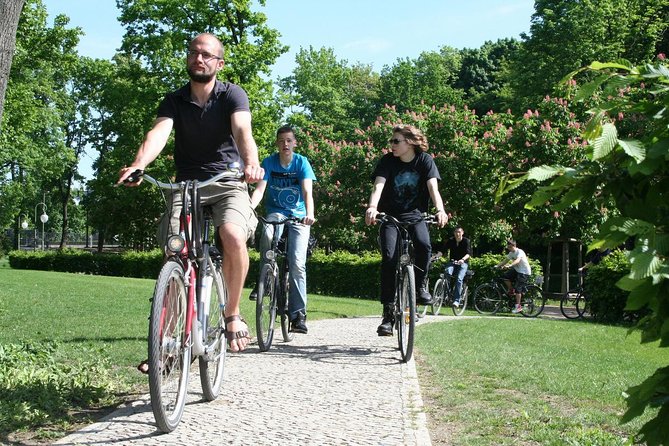
Berlin is one of those cities where getting around is half the fun—and cycling is a smart way to do it. This tour is designed around bike lanes, garden paths, and quiet sidestreets, so you spend less time wrestling with traffic and more time watching how Berlin actually moves.
The format also helps. You’re not just bouncing between famous stops. You’re getting a layered feel for the city: green space in the middle (Tiergarten), neighborhoods tied to Berlin’s early roots (Nikolaiviertel), and places where the city’s history is still visible in the buildings and street names you ride past.
And because it’s a leisurely ride with planned stops, you don’t feel trapped in a museum-only schedule. You get stories, you get the scenery, and you get to reset at each checkpoint.
You can also read our reviews of more cycling tours in Berlin

Getting started at Poststraße 11 and riding in comfort
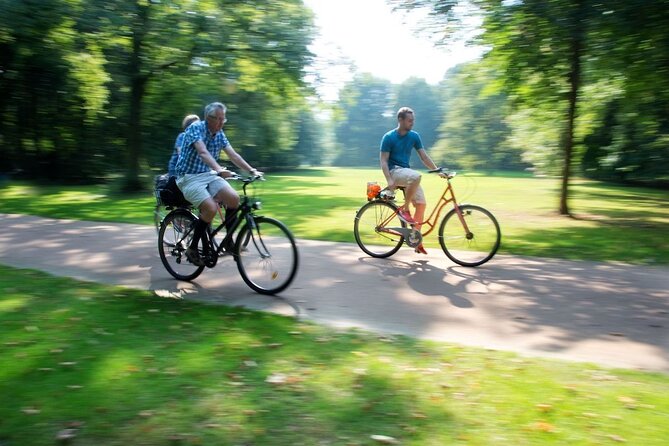
The tour meets at Poststraße 11, 10178 Berlin, and it ends back at the same point. It’s helpful when the start and finish are the same, because you don’t have to build your day around a long end-of-tour transit shuffle.
You’ll have use of an urban cruiser bike and a helmet is included. That matters more than it sounds, especially for a 3-hour tour where you want to feel stable and comfortable from the first pedal push to the last stop.
You also get a mobile ticket, and the meeting point is near public transportation. If you’re planning your day in Berlin, that makes it easier to fit this into a longer itinerary—especially if you’re visiting museums, doing a walking circuit, or connecting to transit lines afterward.
One practical thing to keep in mind: the tour operates in all weather conditions. So even if the forecast looks shaky, treat this as a ride that you’ll likely do in whatever Berlin gives you. Bring something to stay dry and warm enough to ride comfortably.
Tiergarten: Berlin’s central park, seen at bike pace
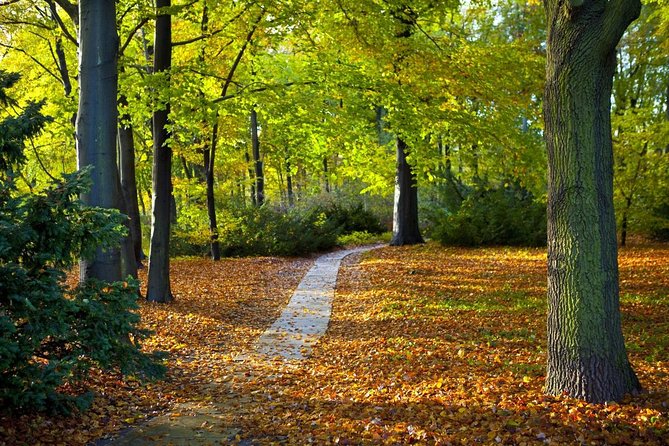
Your mid-tour storytelling begins in Tiergarten, Berlin’s central park. The value here is the viewpoint. On a bike, you can move through a large area without it turning into a long walk, and you’re able to notice how the park sits in the city’s rhythm.
This stop is short—about 30 minutes—but it’s positioned to do something important: give you the contrast. Before you ride into the denser historic pockets, Tiergarten gives you that “big-city green” feeling that Berlin does well.
Think of it as a reset. Even if you’re keen on history, the park segment keeps the tour from feeling like a nonstop string of churches, models, and landmarks. You’ll also likely appreciate the logic of the route: the tour leans on bike lanes and calmer paths to keep the riding easy.
Nikolaiviertel: where Berlin’s origin shows up quietly
Next up is Nikolaiviertel, described as the place of Berlin’s origin. This stop is about 10 minutes, and the big theme is what you see: the quarter was remodeled after destruction during the 1980s.
What I like about this stop is how it frames the neighborhood. Instead of treating it like a static postcard, you’re learning to read it as a place shaped by rebuilding and renewal. For a short tour, that’s exactly the kind of context that makes the streets feel more meaningful.
It’s also described as lovely and quiet in the heart of the city. That combination is why Nikolaiviertel works on a bike tour: you’re not just passing through. You get a moment where the atmosphere changes, so the tour feels like more than a transport session.
Märkisches Museum and the 3D-model view of Berlin’s renewal
At Märkisches Museum, the focus shifts from what happened long ago to how Berlin keeps reshaping itself. You’ll look onto the big 3D-city-models of Berlin, and that’s the point: you’re seeing the idea of constant renewal in a way that a typical street-level explanation can’t always deliver.
This is a strong stop for travelers who like “how the city works” more than just “what city exists.” Models are often used poorly, but here it’s specifically to help you understand Berlin’s ongoing transformation.
You’re given about 15 minutes, so expect a guided explanation tied to what you’re looking at, not a long self-guided museum detour. If you want a quick, visual boost to your understanding of Berlin’s layout and change over time, this is the kind of stop that does that job efficiently.
You can also read our reviews of more tours and experiences in Berlin



Barenzwinger: a name origin story with bears
Barenzwinger Berlin is one of the tour stops that sounds fun even before you know the context. It connects the name Berlin to what it has to do with bears.
The tour gives you about 10 minutes here, which is perfect for a bite-sized story stop. It’s also useful because it shows a different kind of Berlin education: word origins, local lore, and city identity you can carry with you long after the ride ends.
This is also where you’ll probably feel the benefit of having a guide who can explain in clear, memorable ways. In Berlin, you’ll see signs and names everywhere. Stops like this teach you how to notice what those names might be hinting at.
Parochialkirche: religion, destruction, rebuild, and surviving remnants
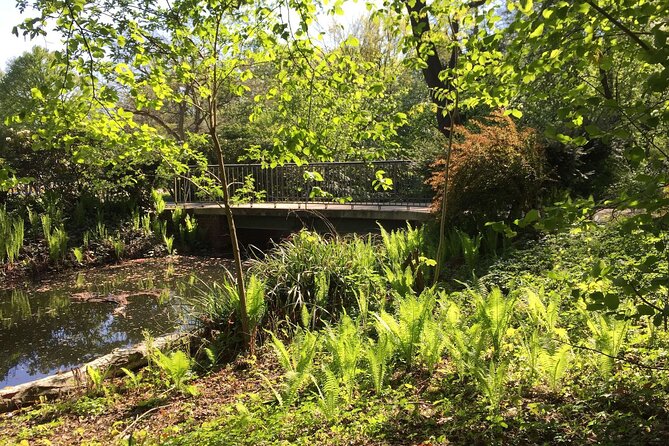
Next comes Parochialkirche, and it’s framed around a specific story line: religion, destruction, rebuild, and designated survivors. You get about 10 minutes, which is enough time to connect the guide’s explanation to what you’re actually seeing.
I like this kind of stop because it’s grounded in the visible. Even if you don’t know the finer details before arriving, the structure of the story—destruction, rebuild, and survivors—gives you a lens.
And because the tour is riding-forward, you’re not stuck in one emotional tone for too long. It’s one stop in a day that also includes parks and lighter oddities like Global Stone Project. That balance keeps the tour from becoming heavy.
Franziskaner Klosterkirche: an abandoned place with medieval memory
Franziskaner Klosterkirche is described as an abandoned place and a rare memorial to Berlin’s medieval history. You’ll have about 10 minutes to focus on that idea.
This stop is valuable because it widens the time period window. Not every Berlin experience takes you to medieval remnants, and on a bike tour the effect is immediate: you’re passing through parts of the city where time layers overlap rather than feeling like a separate museum day.
Also, the word “abandoned” (as a descriptor) matters for how you experience the stop. It’s a moment for quieter attention. If you like places with atmosphere—spaces that don’t try to entertain you but instead let the past sit there—you’ll probably enjoy this segment.
Global Stone Project: Berlin’s Stonehenge and love that isn’t easy
Then you ride to Global Stone Project, described as Berlin’s Stonehenge. It’s also tied to the idea that love can be difficult sometimes.
You’ll have about 15 minutes, and this is likely one of the stops where the guide’s storytelling style matters most. Whether you find it funny, moving, or simply interesting, the point is that it’s a poetic, offbeat landmark integrated into the city.
This also fits the tour’s overall promise: beyond the main sights, into spaces and symbols you might not stumble upon unless someone guides you there.
Hansaviertel: the future of housing from 1957’s viewpoint
Hansaviertel gives you a different type of Berlin lesson. The tour frames it as the future of housing, at least from the year 1957 perspective.
You’ll get about 15 minutes here, so you’re not expected to memorize architectural history. Instead, you’re getting an on-the-ground understanding of how people imagined “what’s next.” That’s a useful way to read the city: Berlin keeps reinventing itself, but it’s also a place where past predictions are still visible.
If you like architecture but don’t want a heavy lecture, this stop is a good fit. You’ll likely leave with a clearer idea of how the city’s planned visions shaped what stands there today.
Clärchens Ballroom: dancing with a morbid charm
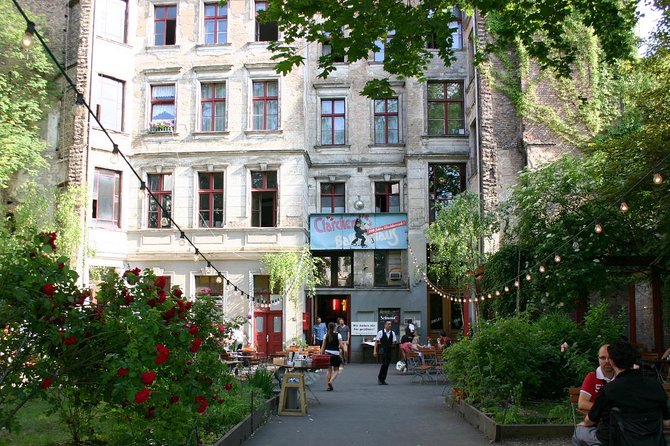
At Clärchens Ballroom, the description leans into mood: forever dancing, surrounded by morbid charme. Expect about 10 minutes.
This is one of those stops that helps Berlin feel like more than monuments. It’s part of the city’s cultural texture—places where the past isn’t only historical; it’s also social and atmospheric.
I find stops like this worth it on bike tours because they break up the “history stops” rhythm. After several heavier reminders of destruction and medieval traces, this gives your brain a different kind of story hook.
Scheunenviertel: courtyard oases, shopping, fine dining, culture, art, and party
The tour ends by heading to Scheunenviertel, described as an urban paradise for the posh, with courtyard oases, decent shopping and fine dining, culture, art, and party.
You get about 15 minutes, and the tour’s job here is to show you the neighborhood’s character in a short time window. What makes this stop practical is that it gives you ideas for what to do after the tour. Even if you don’t stop for a meal right then, knowing the area’s vibe helps you plan your next move.
Also, ending with a neighborhood that feels lively and human-scale can make the last part of a bike tour easier. Instead of finishing in a transit-heavy area or a purely sightseeing spot, you finish in a place where you can keep exploring on foot afterward.
Price and value: is $45.10 worth it?
At $45.10 per person, you’re paying for a guided, 3-hour cycling experience that includes the big essentials: professional guide, bike use, and helmet.
That’s the heart of the value. Berlin can be great for independent cycling, but you’re still paying for equipment, plus you lose the “why does this matter” context that makes a tour memorable. Here, the structure is built to keep the ride easy while the guide provides meaning at each stop.
Also, the booking lead time is described as averaging 13 days. That suggests demand, so if you want the exact day you’re in Berlin, it’s smart to book ahead rather than waiting until the last minute.
Two realistic considerations:
- The tour is German only. If you can’t follow German comfortably, plan around that.
- Food and drinks aren’t included unless specified. One shorter break to buy something to eat and drink would be nice on a 3-hour ride, so I’d recommend carrying a bottle of water and a small snack if that’s your style.
How to choose this tour: who it fits best
This is a good match if you:
- want a fun, active introduction to Berlin without spending your day in a bus crowd
- like history explained in stops rather than long lectures
- enjoy cycling routes that use bike lanes and calmer sidestreets
- want hidden pockets and green space as part of your sightseeing rhythm
It may be less ideal if:
- you need an English-language guide (the standard tour is only available in German)
- you get uncomfortable riding for about 3 hours, even with stops
- you don’t want to think about snacks or drinks at all during your sightseeing day
The group size, 5–15 with a maximum of 15, is also a deciding factor. Smaller groups usually make it easier to hear your guide and ask questions at the stops.
Should you book this Tiergarten and Hidden Places bike tour?
I’d say yes if you want a short Berlin experience that blends green space, historic neighborhoods, and guided context without overcommitting your day. The stop selection is practical: Tiergarten for contrast, Nikolaiviertel and Märkisches Museum for origin and renewal, then a string of specific landmarks that each connect to a clear theme (bears and names, rebuild and survivors, medieval memory, symbolic art, housing visions, and neighborhood vibe).
If you’re traveling with German language comfort and you’re okay planning for your own snacks and drinks, this is a solid value for 3 hours on a bike that includes the key gear.
If you want this experience in English, don’t force it—choose the right version instead, since the standard tour language is German.
FAQ
How long is the bike tour of Tiergarten and Berlin’s hidden places?
The tour lasts about 3 hours.
How much does the tour cost?
The price is $45.10 per person.
What’s included in the price?
The tour includes a professional guide, use of a bicycle, and a helmet.
Is food and drinks included?
Food and drinks are not included unless specified.
What language is the tour offered in?
This tour/activity is available only in German. For English, you’ll need to choose a private tour.
Can I cancel and get a full refund?
Yes. You can cancel up to 24 hours in advance for a full refund. If you cancel less than 24 hours before the start time, the amount paid isn’t refunded.